Showing posts with label Korea. Show all posts

Wednesday, October 15, 2014

Korea Outtakes and Extras


An illustration of awful gender roles: ladies mince, men disco dance.  Also: camera wizardry!


Man do I love this picture.
"Jenn, no, that's now how you put up a tent!"

Saturday, October 11, 2014

Seoul Power


At long last, the bright and sunny Saturday came when we made it back to Seoul.  Right on schedule, as it happens, and even if our schedule for the last few days wasn't the most ambitious one, it sure felt nice to arrive somewhere when we meant to.  It was also encouraging to know that we could go farther each day than we were going, but we just didn't want to.  And we even meant it this time!


We had a guesthouse reserved somewhere on the south side of the river, though not until Sunday; every guesthouse, hostel, motel and yurt in the city seemed to be fully booked for the weekend.  Indeed, from Friday the bike path was obscenely crowded.  Moms in high heels, kids on training wheels far too small, shaky young ladies letting their boyfriends do all the pedaling on their shiny rental tandem bikes.  Day trippers, in short.  Tourists who were as unfamiliar with the rules of the bike path as they were with the basic physics of riding a bicycle.  The racing cyclists, with whom we usually have a steady relationship of mutual distaste, were as peeved as we were: our usual calm, lonely ride on the path became an exercise in sudden braking, passing on the left, and ringing our bells to absolutely no effect.

As we were stuck in traffic for most of the day, it gave our fellow cyclists plenty of time to stare at our back bumpers.  A dozen or more lycra-clad bikers pulled up behind or next to us and chatted about our mission and about how we liked Korea.  Dozens more shouted vague words of encouragement: "Fighting!" "Good travel!" "Cheer up!"

We stopped for a brief lie-down under a highway overpass, and there we were greeted by a middle-aged dude who wanted to compliment our bikes.  We ran through our usual Q&A with him: where we came from, what country we're from, how amazing our trip is, etc..  When our typical conversation topics ran out, though, things took an unexpected turn when he asked us, "Do you like makgeolli?  Let's go drink makgeolli."

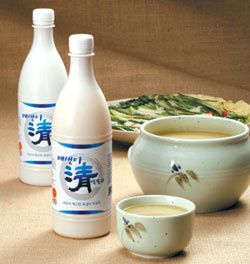
As it happens, yes, we do like makgeolli.  For the uninitiated, makgeolli (prn. MAHK-ko-lee) is a traditional Korean beverage made of fermented rice and also broken dreams.  Less dangerous than soju, more powerful than beer, and it goes extremely well with pajeon.  It's a milky white substance resembling watery sunscreen, though slightly tastier and with a worse hangover the next day.  We'd had many extensive experiences with makgeolli, some of them so amazingly pleasant that we were unable to remember them.

Our new friend led us down the bike path, conveniently in the direction we were already headed.  As we got further into the city center, the path grew increasingly crowded with families hauling camp chairs and coolers.  Before long it was so crowded that we had to dismount and push through the crowd.

"There's a million people here to see the fireworks," our friend told us.  Sure enough, this looked like every other festival we'd seen in Seoul: an impossibly thick crowd pushing past fried chicken stalls or browsing their smartphones on blankets.  There were a dozen vendors selling beondegi and, even more horrifying, a dozen more selling selfie sticks (which, if you haven't had the pleasure, are telescoping rods you use to take a selfie from a greater distance).

"Do you want to stop here and watch the fireworks?" he asked over the din.  We looked at the crowd, then back at our ludicrously loaded bikes.  "Or should we maybe go a little further?"  We agreed to sacrifice a better seat for the fireworks in order to get a few more cubic inches of breathing space.

 At last, we arrived at a 7-11 located at the far end of the river island, Yeouido.  Our friend disappeared into the store while we improbably leaned our bikes against each other, and he came back out with three bottles of makgeoli.

Over the course of the conversation, we learned many things about our friend, Beom Jin (including, eventually, his name).  Sixty-one years old and embarrassed to be so, retired and not terribly happy about it, he lives in Seoul with his wife and three adult daughters.  His real passion, besides biking, was America.  Over and over again he told us about how wonderful America is, how America has the most generous hearts and wisest political minds in the world.  Being the pusillanimous bleeding-heart that I am, I expressed some surprise at hearing this opinion; generally, whenever I learn something about 20th-century American history, it doesn't leave me feeling that USA = #1.  But no, Beom Jin assured us, he knows how great America is: when he was a child in the '50s, he told us, and his family and friends had nothing, it was America and no other country that gave them food and clothing.  It took me awhile to settle down and keep my mouth shut -- I got some opinions about America -- but in the end, I learned something about Korea that I'd always half-known.  Regardless of the US's motivations for intervening in Korea, regardless of some of the nasty stuff that went down in the name of fighting Communism, to Koreans of a certain age, America is the veritable cat's PJs.

Of course, this newfound knowledge didn't last very long before disappearing in a milky white cloud.
 "Hey, it's 7:00, the fireworks should be starting," Beom Jin said.  We craned our heads back the way we came, and sure enough, if you squinted hard enough, you could see distant flashes of red and green flickering through the trees.  A little disappointed by our poor view of the show, we turned back to our conversation.  By 7:10, the fireworks were over.  It was good to know that, of the million people in Yeouido that night, we almost definitely had the best time that night.  Though probably the worst time the following morning.

And then Jenn fell asleep on the sidewalk while we looked for a motel.  But that is a story for another day.

Monday, October 6, 2014

Return to Hell Mountain


This time, we were stronger than before.  The days since Busan were much faster, more productive (though inexplicably, the weeks passed just as quickly as last time, back when it seemed every other day was a rest day or sick day).  We could do more miles with fewer problems, we were smarter about staying out of the rain.  We picked only the best campsites, got more sleep, spent less money, shopped more efficiently, ate better, were better prepared.

Somehow that didn’t make Hell Mountain any different from last time.  The giraffe-print sidewalk was still impossibly steep and coming apart in pieces.  There were still cyclists pedaling up this monster that we could only push up: young college kids, middle-aged moms, grandparents even (though it’s worth pointing out that none of them were carrying violas).  The grade was still a laughable 13%, which probably would have meant something if we hadn't seen gentle slopes marked as a 15% grade and sheer cliffs marked as 5%.  The manure factory was still doing brisk business, seasoning our bitter curses and buckets of sweat with an otherworldly stink.

"I hate this," I said after thirty minutes of pushing.

"Blarrrgh," Jenn agreed.

"At least this time I didn't forget my ukulele."

"Blarrrgh."


At the top of the mountain, there was a congregation of old men and ladies, all clad in flashy new lycra cycling clothes, all of whom had evidently pedaled up the whole mountain.  They laughed as they read our sign while we politely tried not to die of heart failure right in front of them.  One gruff old brute beckoned for us to come over for a photo with him.  We obliged, and after the photo was snapped he started explaining something to his friends; all we could understand was "Foreigners."  He talked about us for a few minutes, and we heard the word, waegukin (gaijin in Korean, essentially) tossed around several more times by the curly-headed ladies.  No one deigned to ask us any questions, though one of the ajumas did give us a big bag of homemade banana chips.  After we had rested sufficiently, we were down the mountain again, our brakes squealing our departure into the cliffs and pines, a solitary voice from behind shouting, "Fighting!"

Before long it had grown dark again.  Hell Mountain was exactly as terrible as we remembered, but it did seem to take up less of our day this time.  Just as it was getting too dark to safely continue, the Travel Gods dropped a beautiful roadside park in front of us.  We proceeded with our usual routine: we played a little music on the ukulele and viola, then set up our stove to cook some dinner.

Yes, it's supposed to do that.  Sort of.
It bears mentioning that in addition to being a proficient world traveler, a proud amateur blues musician, and an all-around scruffy-looking nerf herder, I'm also a damn fine cook.  While it's been tough having to do all our cooking on our one lonely little stove (man, do I miss fresh bread), I've still been able to whip up some excellent dinners from time to time.  Pasta with red sauce and anchovies, vegetable curry, ramen, Chinese noodles, yakisoba, tuna salad, pasta with white sauce, kimchi quesadillas, pasta with sauce of an indeterminate color: I can do it all.  Well, all of the major noodle-based dishes, anyway.

Just as I switched off the stove and we began wolfing down our chanko nabe, we heard a metallic ting come from somewhere in the dark woods around us.  We put down our chopsticks and listened: there was singing as well.

"I don't think I like the movie we're in," Jenn said, laughing nervously.

"It's probably...uh...maybe a temple somewhere in the woods down there?" I suggested, and we slurped our soup and tried to believe it.  The woods echoed with chanting now, whistly voices carried on the woods and filtered through innumerable spiderwebs.  Gongs, maybe, cymbals or bells and a steady thump that we hoped was our heartbeats.

When we finished the last of our dinner and set up the tent in the shadow of the roadside pavilion, I caught sight of something across the river: though it was almost too distant to see, especially viewed through the pine boughs, it appeared that there were figures dancing in a circle and beating drums on the unlit grass.  The singing must be coming from there, we decided, and relaxed slightly.  If it was indeed some manner of religious ritual, at least we were probably too far away to be in danger of human sacrifice (or worse, being asked to dance with them).  The voices and drums dropped away not long after we zipped our tent and instantly fell into sleep, though the forest seemed to sing and chime long into the night.

Can you spot our tent in this picture?  Oh man, you can?  Crap, start packing up, we gotta get outta here!

Thursday, August 21, 2014

Return to Japan

By the end of our trip in Korea, things were looking rather grim.  We'd run into bike trouble, weather trouble, illness, bad directions, and gross bugs.  At one point, we pushed up a 20%-grade mountain road for half an hour only to find a 25% grade on the other side.  With bad brakes, traveler's diarrhea, and ominous buzzing noises filling the air.  Our nerves were getting a bit frayed by this point.  We began to indulge in hotel rooms...

Which do lift the burden a lil'.

Even when the decor leaves something (sanity) to be desired.
And while we didn't ever get down to the eating-our-shoes phase of hunger, we did fall upon some fairly desperate measures, such as the fated Peanut Butter and Ham Sandwich.
The poor man, he's dying.
It hardly needs saying at this point, but bike touring is hella hard.  Even though we'd rather be doing this than anything else in the world (anything you can accomplish with English teacher money, anyway), there are lots of times when days of rain and stomachaches can weaken your willpower and make you willing to do anything in exchange for a cold beer and a hot shower.  Yes, those were dark days there, when we were almost ready to give up entirely and just go back to work for the Man, trading in our freedom for a relatively clean apartment and not having to push ourselves another inch down the road.

Fortunately, by this point we had arrived at Busan.  There, we were able to catch a much faster mode of travel: big ol' boat!
Now, you might wonder why we choose to travel by ferry so much rather than by airplane like normal people (even if you are entirely uncurious, just play along).  The simple answer is that traveling by plane involves many extra, extremely expensive steps if you have bicycles, most of which are unnecessary when going by ferry.  The complicated answer is exactly the same but involves several largely irrelevant opinions about chemtrails and the Kennedy assassination.

Unfortunately, taking the ferry isn't always a barrel of roses (or whatever you use to transport multiple roses).  Different ferry companies have different regulations for taking loaded touring bikes, and these are frequently much more obnoxious when traveling internationally.  The easiest time we've had with a ferry, we just wheeled our bikes right into the car-carrying location (or "stern"), where several able-bodied sailors tied them to big, sturdy metal girders.  The hardest was going from Japan to Korea, where we were made to partially disassemble our bikes, then strap our unwieldy panniers and sleeping bags together with bungees into large, even unwieldier mega-bags.

This time, leaving Busan was a particularly frustrating affair.  The check-in window was mobbed by a crew of 30 or so exchange students from somewhere European, none of whom were sure if they needed their passports to check in.  By the time we paid for our tickets, the person at the ticket window had moved on to the next passenger without telling us what to do with our extremely cumbersome bicycles.  The information window was staffed by a pair as entertaining as they were unhelpful: a chipper, very confused older man and his stern, no-nonsense partner.  This duo managed to tell us to take our bikes upstairs to the departure lounge in between guessing if we were Australian and answering the telephone in English.  Now that the stress of the moment has worn off, I kind of love those guys.

By the time we got to the departure lounge, roughly two hours before the boat was scheduled to leave, we realized just how much we still had to get done.  What were we going to eat during the 18-hour voyage?  Where should we take our bikes?  Could we buy souvenirs for our friends in Osaka?  Should we?  And for god's sake, where could we get a drink around here?

We did manage to get all of these problems sorted out in an extremely boring, non-stress-worthy manner, and just in time to line up for departure, too!  My mind drifted back to the last time we went through customs in Korea.  When Jenn set off the metal detector, she indicated that it was her belt, which she began to unfasten to cooperate with security as is the American fashion.  The response of the security team was lightning-quick: they all ran the hell away, leaving us to stroll through the door, apparently cleared for entry.

I was yanked back to reality by a frantic-looking young man in glasses wielding a walkie-talkie, who gestured to our bikes, explained something in Korean, and indicated that we needed to follow him with head-on-fire urgency.  We were treated to a race through the ferry terminal that would have been downright hilarious if scored with "Yakkity Sax" (through really, what wouldn't be?), culminating in taking all of our possessions off our bikes, running them through a metal detector, then immediately strapping them back on.  Sadly, we were not congratulated with this last-second success with a vigorous high-five, but rather a big fat cargo bill, which we glumly paid.

"OK, come on, you have to hurry upstairs to customs," the terminal employee admonished us.  We looked back at our bikes, where an elderly cargo handler was still squinting and shaking his head at them.  I shrugged and headed back to the elevator.

"Hey, H," Jenn called to me, and I stopped to look back.  "We have to make sure they have our bikes."

"I'm sure it's fine," I told her, and gestured toward the baffled-looking gentleman in a vest.  Look at this crack team they've got working on our problem, I told her with my gesture.

"They already messed up once," she snapped at me.

Bill and I exchanged a look.  "Thank you very much," he said to the clerk who had just billed the crap out of us.  I jerked a thumb towards the employee who shepherded us down to the loading area, who was sweating bullets and beckoning us to hustle onto the boat.

Jenn glared at the lot of us.  "We can't expect other people to give a shit about our stuff, Harry."  I realized she was right.  "These bikes are very expensive," she told the clerk, who nodded absently.  The glasses-wearing employee grew increasingly elaborate with his pacing and foot-tapping, trying in English and Korean alternately to explain to us that the boat had almost certainly left by now.  Finally, excruciatingly, the lone, infirm cargo handler began wheeling our bikes out of sight, and we took off running (well, almost) to the departure gate.


At last, we made it onto the ship, the Panstar Dream, the same ferry that ushered us into Korea for the first time way back in 2012 (which happened to be staffed by the same largely-ignored foreign musicians playing electric cello in the lobby).  We celebrated our departure from Korea in the style of our people, American 20-somethings:

Half a bottle of soju, and you'd be king of the world, too.
It bears mentioning that Jenn's message, the moral of this whole episode, was borne out: when we retrieved our bikes from the cargo hold in Japan, two of Bill's spokes were broken, and one of Jenn's fender was badly bent.  True enough, you can't expect others to give a shit about what's important to you.

And with that somewhat somber lesson, we bid farewell to Korea.  Like all our farewells, this one came from a place of deepest sentiment, as well as a place of knowing that we'd be back in a few months.  Time to get back to our first love:

That's right: stuffing our faces in front of Japanese convenience stores.

Tuesday, August 19, 2014

The Story

This cute little guy was living in a soju box outside of a country store.  We kept each other company for an hour, I took a photo, and I decided to share that photo with you.  Because the Internet needs another cat picture.

Something funny happens over the course of a bike tour.  Each day we wake up in a different park, bike as far as we can, eat our (six or seven) meals, and set up somewhere new when the sun goes down.  We make our progress inch by inch and mountain by mountain, and we get where we're going in the end.  Whenever we speak to another human being about our trip, though, the story that we tell changes.

Two weeks?  No, no, we've only been on the road for one.  Where did we start today?  Surely it was Yangpyeong, an impressive distance to cover in a few hours (and considerably more impressive than the day and a half we've actually taken to get here from there).  And of course, the answer to "Are you camping here?" is always a resounding "No!" followed by a laugh of disbelief.  (Even with our near-perfect record of never being shooed away from an impromptu campsite, we are still leery of being discovered in our probably-illegal but entirely harmless antics.)
So we engage in vigorous exercise to pass the time until the sun goes down.
Far and away, the most onerous question came after we told people that we started in Seoul.  About half the time we told people this, they followed up with, "Today?"  This happened a hundred kilometers, two hundred kilometers from Seoul or more.  To make the kind of time these people were thinking, we would have had to ride our bikes at least fifty kilometers an hour.  Clearly we had no problem correcting these peoples' misconceptions -- two hundred kilometers takes us over a week, even over flat terrain with no setbacks -- but the fact that these people thinks that a cyclist could cover 200 kilometers in a morning means that they don't know from cycling (and also, that our honest numbers can only fail to impress by comparison).

This editing of our timeline is not the result of a coordinated attempt to deceive; we don't put together fake itineraries to give to curious passersby, nor do we particularly care if anyone does know that we generally only go forty or fifty kilometers a day.  Still, all the same, it comes out.  We're called on to account for our distance, and without thinking, we omit two nights' sleep from our recollection and call it honest enough.  I don't think there's anything particularly malevolent about it; in the end, we come off as slightly more fit than we are to someone who, typically, has no idea what bike touring entails.  Of course, we are really just encouraging this kind of ignorance when we exaggerate our numbers, and that leads to some pretty bum directions, such as "Oh yeah, there's a campground real close, it's just over those mountains and go straight for sixty or so kilometers, you should be there in an hour."


The point, such as it is, is that it's awfully hard to describe exactly what it is we're doing, even under the best of circumstances.  To those who've never toured by bicycle, our fifty kilometers per day seems like either an impossibly high or pitifully low number.  We go slower than other cyclists, too, but we try not to let that get to us (one guide to the Four Rivers Project suggested that tourists try not to go more than a hundred kilometers per day, y'know, so they don't miss too much of the scenery).


The twisted, disturbing scenery.
Sometimes, of course, we get an entirely different reaction from passersby.  Sometimes, as in Japan, they give us encouragement.  And presents!  Horrible, inedible presents!

"It stinks!"
This gentleman watched us cook our lunch in a public gazebo, interrupting with an occasional question and to show us that he was documenting our meeting on Facebook.  When we were finished with lunch and ready to leave (so, say, two hours), he produced a dozen sealed packets of mysterious brown liquid from somewhere and presented them to us with a smile.  There were few clues to the contents on the package; there was a picture of a log, but that couldn't be right, could it?

To make sure we weren't being (intentionally) poisoned, we politely waited for the guy to crack open one of the packets and take a sip.  He downed his in a few seconds and smacked his lips, then gestured to us with an open hand.  Satisfied that the packet must contain something delicious and refreshing, Bill opened it, took a drink, and with a petrified smile, passed it to Jenn.  "Oh wow, it's so good," he said through his teeth.  "Mmm!" agreed Jenn, before giving it to me.  I didn't give much though to their crocodilian smiles and took a hearty swig.  The taste is difficult to describe, but it's somewhere between mothballs and sawdust, with a healthy chemical aftertaste.  We posed for a photo with our friend, who insisted (I think) that we take the rest of the liquid with us for the road.  I finally got around to throwing it away last week, 400 kilometers down the road.

Oh, and the dictionary did yield some end to this mystery: it was arrowroot stock.  Or poison.

Tuesday, August 5, 2014

Park Place

The route we chose to take on our trip across Korea follows the Four Rivers Bike Path, an expensive undertaking completed in 2011 by the Korean government to promote environmental awareness, international understanding, and tourism.  As it happens, the Four Rivers Project turned out to be a bit of a boondoggle (or, in Korean, a "kerfuffle"); the project was wildly expensive, incredibly damaging to local ecosystems, and tainted by accusations of corruption and cronyism.

We had all this in the backs of our minds from the beginning of this trip, but for the most part, we didn't pay any mind to the haters.  I mean, sure, some parts of the path are decidedly non-eco-friendly (long, freestanding platforms built right over the water, asphalt bike paths cutting through wetlands), but large sections of it consist of little more than bike logos painted on existing roads:


No, Bill, wrong way!
Once we got out of the sprawl of Seoul, though, we started stumbling across these vast, brand new yet mysteriously un-maintained parks.  And these parks are extremely well stocked.  They have elaborate maps and welcome signs that are completely covered in cobwebs.  They have excellent bathrooms (that is, they have bathrooms with toilet paper and non-squat toilets).  They have beautiful, elaborate landscaping that, except for small mowed patches, are being swallowed by weeds.  They have artsy benches and shelters, but no visitors using them.

Pictured: artsy shelters.  There were also bathrooms build to look like huge bicycles and bike racks in the shape of...bicycles.  I guess they stuck with a theme.


They were fully stocked with all of your major spiders, too.
And sure, some of them were less than perfect.  Many of the parks are badly designed, with nowhere to sit and rows of skinny trees that provide no shade.  Most of them are covered in snake-concealing tall grass or thorny plants.  For bike hobos like us, though, these parks were an amazing discovery.  Overgrown, unpopulated, and with all the resources we could want for free camping.  Our usual free camp routine is to pull in, unobtrusively cook our dinner, and set up our tent only in the most secluded corner of the park (even if that puts us on a gravel lot behind a bathroom), and only then after it has grown too dark to be spotted.  In the mornings, more often than not we were awake and had our tent away by 6:30 before we could be spotted by joggers or local busybodies.

In the vast abandoned parks of Korea, though, it's a different story.  We stake our tent in broad daylight like goddamn kings.  We sleep in until 7:00, even 8:00, sometimes not even putting up the tent until after a cup of coffee.  On rest days we simply leave the tent up, and we greet the (very) occasional dog walker or hiker with a hearty "Annyeong haseo!", knowing that even if we're somehow bothering them with our presence, there'll be another park not ten kilometers down the road.


It did occur, though, after our third or fourth day without seeing another cyclist, camper, or picnicker, that these parks could be part of the problem with the Four Rivers Project.  There were all manner of signs directing us to these parks and the Historic Views of the Han River or the Historic Cosmos Garden (currently unoccupied by cosmos), and even on the weekends they were utterly failing to bring in tourists or even members of the community.  The cost to build and maintain these parks is surely immense, and as far as we could tell, the only people making use of them are three smelly hippies.

So are these parks a good thing?  For us, certainly, but I don't think we're supposed to be the main beneficiaries of the Four Rivers Project.  I'm not particularly bothered by the thought of my tax dollars going to build such elaborate parks or bike trails; projects like these do bring people closer to nature, particularly those who live in a city and don't see much nature anyway, and it's a lot easier to care about the environment when you can point to a river or a forest as a good thing in your daily life.  But then, I don't pay that much in taxes.  Maybe I'd be more bothered by how abandoned, how clearly unnecessary these parks are if I were more invested in one of the communities that hosts them.  And I do think these parks are rather unnecessary, beautiful though they are: if on a beautiful summer day, they sit unused by either members of the community or tourists, then how necessary could they be?

The real takeaway here is that we're extremely lucky to be doing this trip when we are.  Four years ago, these paths would've still been under construction, and we would have had to fight mountains and traffic the whole 600 kilometers to Busan (whereas now we only sometimes have to).  And who knows?  Maybe four years from now the path will be swallowed up by weeds entirely or else abandoned by the taxpayers as a waste of money.  Then again, maybe in twenty years, when the urban sprawl has covered most of the country, these young trees will have grown big enough to provide some shade, and the currently unused parks will be the last bit of greenery that the citizens of Korea will have to enjoy.

I guess maintenance costs couldn't be that high, really.
PS: As a way of saving my delicate little princess skin from the ravages of sunlight, I caved and bought some ajuma arm...cover...things.  But at least mine show the other old ladies that I shanked a dude in the pen:

Also available in "regrettable band logo."

Sunday, July 27, 2014

The Strangeness of Kindness

We’d always talked about sticking a sign somewhere on the backs of our bikes.  Nothing fancy, maybe just some cardboard covered in packing tape, explaining who we are and what we’re up to in the native language.  Somehow we never quite got around to it the last time around (living in a tent and biking all day tends to eat up your free time).  This time, though, we were ready.  With the help of our Korean teacher, we made up a laminated sign designed to spark conversations with curious passersby and also reassure them that we are neither hobos nor circus performers, no matter how funny we look:

Translation: We are traveling the world by bicycle!  Let’s share together (conversation/stories, music, food...)!  We speak a little Korean!  Thank you!
By day two of the trip, we were in need of a little tender kindness.  We made it out of Seoul considerably later than we’d planned, and come nightfall we found ourselves with nowhere convenient for camping.  At last, in the middle of a crowded park, we discovered that there was a small, sheltered patch of grass behind a stage.  Not perfect, but we thought it’d do in a pinch.  Not ten minutes after we’d zipped ourselves into the tent, at 10:30 on Saturday night, who should wander by but a practicing saxophonist.  Pleasure at such gentle music to serenade us to sleep quickly shifted into horror as he went on to play “My Way,” no joke, seven or eight times consecutively.  Then, when he finally stopped and we relaxed once more, he began to play again, this time right next to our tent.  He could’ve been inside the tent, for all I know; I refused to open my eyes.  It was a rough night, is what I’m saying.


The next day, we hit the trail early, but four hours of sleep really took their toll.  By midday we were wilting under the hot July sun, and by three o’clock we had to stop for a nap by the roadside.  We were passed, as usual, by a parade of lycra-clad cyclists zipping down the path.  Some of them stopped to read our sign; many of them laughed, and a couple gave us candy to cheer us up.

Just as we were getting ready to saddle up again, a nice-looking middle-aged man pulled up, read our sign, and began to ask us questions about our trip.

“I was hoping to meet someone who could come give a talk about biking at my children’s school,” he told us, and in an instant, Jenn was fully awake.

“We’d love to!” she said.  “But we need a place to camp.  Could we camp at your school?”

“Oh, I’m not a teacher there, but you can camp at my house, no problem.”  He told us to call him Lee, and asked us to follow him to his house, about half an hour down the road.


Lee’s house is a little patch of heaven right next to the bike path, overlooking the sunset over the mountains and the river.  He asked us to set up in a patch of weeds, then suggested we shower before joining the family for dinner.  Reeling at this kindness, we did as he asked (covered in two days of sweat and road grit, the shower was more a courtesy for them than for us).

Between our showers, Lee showed us photos from his family's trip to Death Valley.  When we expressed surprise that someone would choose Death Valley as their vacation destination, he told us it was a Creationism-themed tour, and that Death Valley was a place of note in the Noah's Ark myth (and thus, evidence against the existence of evolution).  I politely asked no follow-up questions.

“My wife will be back from church around 8 o’clock, but until then, let’s start cooking,” he said, and put me to work grilling meat over the fire his kids had built.  We were supervised by the family dogs, who made sure we didn’t waste a single drop of grease.

"You're gonna get an immersive English lesson!" Lee told his kids.  They seemed unimpressed.

The dish I was asked to help cook is one of Korea's specialties, samgyeopsal, sometimes translated in English as "bacon steak."


Just when the meat was all finished, three people walked up to the house and were introduced to us as their priest, his wife, and Lee’s wife, Ji-young.  They explained that they had already eaten after church, and just watched as the rest of us went to town on a pile of meat.  Then, when the meat pile was reduced to rubble, the dinner turned to drinks and the priest and his wife excused themselves.

Over a glass of homemade makgeolli, Lee asked us, "Are you Christian?"  Bill and I stalled out, but Jenn charged in with "I mean, we're American, so..."  Ji-young laughed and slapped the table.  "Of course they're Christian," she chided her husband.  "They're American, everybody in America is Christian."

I kept my damn mouth shut.  If I were to pretend to be any religion, I'd prefer to be Fake Jewish to Fake Christian.  That said, questions like "Are you a Christian?" make me naturally nervous.  Six years living in rural Missouri has taught me that those most prone to asking questions like that are the ones who care pretty hard about what answer you give.

When asked, I wanted to say, "No, absolutely not, and it's downright offensive to say that there are no non-Christian Americans!"  But I didn't want to offend our hosts by starting a screaming match.  Especially when they had shown us such kindness and hospitality.  That is the side of Christianity that six years in Kirksville had not prepared me for: Christianity not as political position or a club with which to menace college students on the quad, but as a philosophy of kindness.  Even the same brand of Christianity that spends thousands on vacations that celebrate the non-existence of basic scientific principles, even this kind can be held by these kind, lovely people who would invite strangers into their home.


“Hey, didn’t you want us to speak at your school?” Jenn asked when the makgeolli had run out and a bottle of tequila opened.

“Oh, my teacher friend didn’t answer his phone,” Lee said.  “Just come back here when you’re coming back to Seoul from Busan.”  We promised we would.

After friending each other on Facebook, of course.