Showing posts with label Four Rivers Bike Path. Show all posts

Wednesday, October 15, 2014

Korea Outtakes and Extras


An illustration of awful gender roles: ladies mince, men disco dance.  Also: camera wizardry!


Man do I love this picture.
"Jenn, no, that's now how you put up a tent!"

Saturday, October 11, 2014

Seoul Power


At long last, the bright and sunny Saturday came when we made it back to Seoul.  Right on schedule, as it happens, and even if our schedule for the last few days wasn't the most ambitious one, it sure felt nice to arrive somewhere when we meant to.  It was also encouraging to know that we could go farther each day than we were going, but we just didn't want to.  And we even meant it this time!


We had a guesthouse reserved somewhere on the south side of the river, though not until Sunday; every guesthouse, hostel, motel and yurt in the city seemed to be fully booked for the weekend.  Indeed, from Friday the bike path was obscenely crowded.  Moms in high heels, kids on training wheels far too small, shaky young ladies letting their boyfriends do all the pedaling on their shiny rental tandem bikes.  Day trippers, in short.  Tourists who were as unfamiliar with the rules of the bike path as they were with the basic physics of riding a bicycle.  The racing cyclists, with whom we usually have a steady relationship of mutual distaste, were as peeved as we were: our usual calm, lonely ride on the path became an exercise in sudden braking, passing on the left, and ringing our bells to absolutely no effect.

As we were stuck in traffic for most of the day, it gave our fellow cyclists plenty of time to stare at our back bumpers.  A dozen or more lycra-clad bikers pulled up behind or next to us and chatted about our mission and about how we liked Korea.  Dozens more shouted vague words of encouragement: "Fighting!" "Good travel!" "Cheer up!"

We stopped for a brief lie-down under a highway overpass, and there we were greeted by a middle-aged dude who wanted to compliment our bikes.  We ran through our usual Q&A with him: where we came from, what country we're from, how amazing our trip is, etc..  When our typical conversation topics ran out, though, things took an unexpected turn when he asked us, "Do you like makgeolli?  Let's go drink makgeolli."

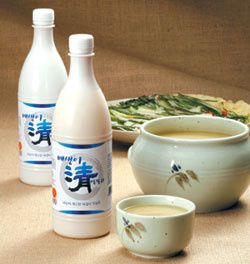
As it happens, yes, we do like makgeolli.  For the uninitiated, makgeolli (prn. MAHK-ko-lee) is a traditional Korean beverage made of fermented rice and also broken dreams.  Less dangerous than soju, more powerful than beer, and it goes extremely well with pajeon.  It's a milky white substance resembling watery sunscreen, though slightly tastier and with a worse hangover the next day.  We'd had many extensive experiences with makgeolli, some of them so amazingly pleasant that we were unable to remember them.

Our new friend led us down the bike path, conveniently in the direction we were already headed.  As we got further into the city center, the path grew increasingly crowded with families hauling camp chairs and coolers.  Before long it was so crowded that we had to dismount and push through the crowd.

"There's a million people here to see the fireworks," our friend told us.  Sure enough, this looked like every other festival we'd seen in Seoul: an impossibly thick crowd pushing past fried chicken stalls or browsing their smartphones on blankets.  There were a dozen vendors selling beondegi and, even more horrifying, a dozen more selling selfie sticks (which, if you haven't had the pleasure, are telescoping rods you use to take a selfie from a greater distance).

"Do you want to stop here and watch the fireworks?" he asked over the din.  We looked at the crowd, then back at our ludicrously loaded bikes.  "Or should we maybe go a little further?"  We agreed to sacrifice a better seat for the fireworks in order to get a few more cubic inches of breathing space.

 At last, we arrived at a 7-11 located at the far end of the river island, Yeouido.  Our friend disappeared into the store while we improbably leaned our bikes against each other, and he came back out with three bottles of makgeoli.

Over the course of the conversation, we learned many things about our friend, Beom Jin (including, eventually, his name).  Sixty-one years old and embarrassed to be so, retired and not terribly happy about it, he lives in Seoul with his wife and three adult daughters.  His real passion, besides biking, was America.  Over and over again he told us about how wonderful America is, how America has the most generous hearts and wisest political minds in the world.  Being the pusillanimous bleeding-heart that I am, I expressed some surprise at hearing this opinion; generally, whenever I learn something about 20th-century American history, it doesn't leave me feeling that USA = #1.  But no, Beom Jin assured us, he knows how great America is: when he was a child in the '50s, he told us, and his family and friends had nothing, it was America and no other country that gave them food and clothing.  It took me awhile to settle down and keep my mouth shut -- I got some opinions about America -- but in the end, I learned something about Korea that I'd always half-known.  Regardless of the US's motivations for intervening in Korea, regardless of some of the nasty stuff that went down in the name of fighting Communism, to Koreans of a certain age, America is the veritable cat's PJs.

Of course, this newfound knowledge didn't last very long before disappearing in a milky white cloud.
 "Hey, it's 7:00, the fireworks should be starting," Beom Jin said.  We craned our heads back the way we came, and sure enough, if you squinted hard enough, you could see distant flashes of red and green flickering through the trees.  A little disappointed by our poor view of the show, we turned back to our conversation.  By 7:10, the fireworks were over.  It was good to know that, of the million people in Yeouido that night, we almost definitely had the best time that night.  Though probably the worst time the following morning.

And then Jenn fell asleep on the sidewalk while we looked for a motel.  But that is a story for another day.

Wednesday, October 8, 2014

Cramping


By now, I've become something of an expert at free/wild camping, at least in Korea.  The bike path is dotted with parks and rest areas every dozen kilometers or more, and it's usually not a problem to find a relatively flat patch of land where we can set up our tent unobtrusively.  In recent weeks, we've really gotten cocky about it, too: whereas in the past we'd always try to have the tent down before anyone might wander by, now we've moved on to the "meh" method.  After months of free camping in Korea and Japan, we've been spotted dozens of times by joggers, dog walkers and cyclists, and never once have we had anyone hassle us or tell us to move on.  As long as we try to keep mostly out of the way, we get some curious looks and the rare greeting or question, but never anything more.


After 200 kilometers of (mostly) beautiful bike path, we were once again approaching Daegu.  Last time coming through Daegu, we found a free public campsite right under a highway overpass in the city.  It wasn't the best night's sleep, but it beat the alternatives, which at that point were setting up in a baseball diamond or dying on our feet from lack of sleep.  It was a relatively comfortable site, if only because I sleep better when I don't think that every rustle in the night is the Man coming to throw me in the vagrants' jail (which I assume is a thing).  Our enjoyment of the site was slightly diminished in the morning when an old lady suffering from extreme crankypantsedness confronted us, accused of littering, and told us that we had to move along and that the campsite was only open on weekends.  Then she stole the tie to our rainfly, apparently her hunger for cleaning up trash being so insatiable.

Still, since we'd be coming into Daegu on a Friday, we figured this campsite would be a good place to take a rest day for free.  Sure, we'd much rather stay in a motel, especially since our body odor had progressed from "P.U." to "biohazard," but we decided it would be best to save the money and enjoy the free campsite.  Besides, since it was mid-September by this point and the summer holiday was over, surely we'd have the place to ourselves.

Hahahaha no.  Please note our tent being ganged up on by a pack of larger tents.
Every inch of dirt in this campsite -- this cramped, smoggy, noisy campsite located right under a highway overpass -- was occupied by a tent.  But really, "tent" doesn't do it justice:

"Juggernaut," maybe, or "Colossus."  Or some other X-Man.
Our trusty tent has everything that a couple of campers could need: a place to lie down, flaps to keep out animals, a space to put our stuff to keep it dry, and vents to let out farts and such.  These monstrosities not only had the room to sleep a dozen people, but for those dozen people to dance to "Y.M.C.A."  Our fellow campers brought quite a load of stuff, too: coffee tables, bookshelves, chairs, tarps, stoves, actual literal kitchen sinks.  Many of them were engaged in what I'm told is called "day camping," meaning they packed their chandeliers etc. into their cars, drove to the campsite, set up all of their stuff, hung around awhile, then packed up again and left.  I guess I find nature hard to enjoy without my grand piano, too.

And what's camping without a complete lack of mosquitoes?


It took me several minutes to figure out what this man in the official-looking vest was doing.  He drove his motorcycle, which was rigged with some kind of pollution-spewing device, in circles along the pedestrian paths of the campsite and park.  Clouds of gray-blue smoke drifted across the trees and swallowed up children in the playground.  If he wasn't killing mosquitoes, then the only other thing I can think of is that he's a supervillain and that the secret to successful nefarious schemes is just to look like you're authorized.

I really can't stress this enough: this man was driving around a campsite full of children, spewing clouds of pure DEET everywhere he went.  It got in our tents, it got in our eyes and our lungs.  He was apparently supposed to do this.  Oh, and there were still mosquitoes.

We found a spare plot somehow, put up our tent, and tossed and turned through a night of streetlights, truck horns, and bedtimeless children holding some kind of screaming competition.  In the morning, we resolved to try to stick it out for another day, although the idea that we'd get any rest was becoming more ridiculous with each additional tent that sprouted up and surrounded us.  Any of the things that we might like to do to relax (play music, draw pictures, cook) we'd have to do under a microscope, on display for dozens of families and their pets and furniture.  When the cranky old lady from last month reappeared and started nosing around our tent, we decided to move on to a motel afterwards.  Another family claimed our spot before our tent was half down.  We left them to enjoy the mosquitoless, cramped, heavily-trafficked great outdoors.

The only bright spot is that we got to see an artist paint these murals on the overpass columns.  Though I guess he could ahve just been the world's most brazen graffiti artist.
As we continued down the bike path for the next few weeks, we found another increasingly popular twist on camping known as "glamping."  We spotted multiple signs for "Glamping Korea," more than we saw even two months before, and eventually we sighted a few...glampsites?

All the beauty of a cult compound in the great outdoors!
Essentially, glamping (which apparently does exist outside of Buzzfeed, and also is not a real word) seems to consist of renting cabins for the night.  Except these cabins are made of fabric.  Shiny new fabric, sure, with pretty new electric light fixtures, but fabric that will start to show its age considerably faster than more old-fashioned cabin construction materials (like, say, wood).  Presumably inside of these tents there's some sort of glamorous setup, like...a disco ball?  Bearskin rug?  Man, I have no idea.  And neither, presumably, does anyone else in Korea: every glampsite we saw was utterly vacant.  No glampers looking for a glamp-out at the moment (ugh).

We decided that we pitied the poor souls who so thoroughly populated that awful campsite.  Why would anyone choose to camp in conditions that so little resemble actual camping?  If they're going to bring their air conditioners and beds, why not just stay home, where all those things already exist?  And why would someone drive all the way to somewhere outside just to spend the day sitting in a tent and then go home before dark?  Jenn eventually hit on a more compassionate explanation than I could muster: they most likely came from elsewhere in the city of Daegu, and this must be the closest any of them can get to having a backyard.  Apartment life doesn't lend itself to neighborhood barbecues or kids running around freely.  Even if this campsite has none of the benefits of camping that we enjoy every night, it's not a solitary encounter with nature that these people are looking for, but just a little bit of sunshine, even if it's filtered through smog and thousand-dollar tents.

Monday, October 6, 2014

Return to Hell Mountain


This time, we were stronger than before.  The days since Busan were much faster, more productive (though inexplicably, the weeks passed just as quickly as last time, back when it seemed every other day was a rest day or sick day).  We could do more miles with fewer problems, we were smarter about staying out of the rain.  We picked only the best campsites, got more sleep, spent less money, shopped more efficiently, ate better, were better prepared.

Somehow that didn’t make Hell Mountain any different from last time.  The giraffe-print sidewalk was still impossibly steep and coming apart in pieces.  There were still cyclists pedaling up this monster that we could only push up: young college kids, middle-aged moms, grandparents even (though it’s worth pointing out that none of them were carrying violas).  The grade was still a laughable 13%, which probably would have meant something if we hadn't seen gentle slopes marked as a 15% grade and sheer cliffs marked as 5%.  The manure factory was still doing brisk business, seasoning our bitter curses and buckets of sweat with an otherworldly stink.

"I hate this," I said after thirty minutes of pushing.

"Blarrrgh," Jenn agreed.

"At least this time I didn't forget my ukulele."

"Blarrrgh."


At the top of the mountain, there was a congregation of old men and ladies, all clad in flashy new lycra cycling clothes, all of whom had evidently pedaled up the whole mountain.  They laughed as they read our sign while we politely tried not to die of heart failure right in front of them.  One gruff old brute beckoned for us to come over for a photo with him.  We obliged, and after the photo was snapped he started explaining something to his friends; all we could understand was "Foreigners."  He talked about us for a few minutes, and we heard the word, waegukin (gaijin in Korean, essentially) tossed around several more times by the curly-headed ladies.  No one deigned to ask us any questions, though one of the ajumas did give us a big bag of homemade banana chips.  After we had rested sufficiently, we were down the mountain again, our brakes squealing our departure into the cliffs and pines, a solitary voice from behind shouting, "Fighting!"

Before long it had grown dark again.  Hell Mountain was exactly as terrible as we remembered, but it did seem to take up less of our day this time.  Just as it was getting too dark to safely continue, the Travel Gods dropped a beautiful roadside park in front of us.  We proceeded with our usual routine: we played a little music on the ukulele and viola, then set up our stove to cook some dinner.

Yes, it's supposed to do that.  Sort of.
It bears mentioning that in addition to being a proficient world traveler, a proud amateur blues musician, and an all-around scruffy-looking nerf herder, I'm also a damn fine cook.  While it's been tough having to do all our cooking on our one lonely little stove (man, do I miss fresh bread), I've still been able to whip up some excellent dinners from time to time.  Pasta with red sauce and anchovies, vegetable curry, ramen, Chinese noodles, yakisoba, tuna salad, pasta with white sauce, kimchi quesadillas, pasta with sauce of an indeterminate color: I can do it all.  Well, all of the major noodle-based dishes, anyway.

Just as I switched off the stove and we began wolfing down our chanko nabe, we heard a metallic ting come from somewhere in the dark woods around us.  We put down our chopsticks and listened: there was singing as well.

"I don't think I like the movie we're in," Jenn said, laughing nervously.

"It's probably...uh...maybe a temple somewhere in the woods down there?" I suggested, and we slurped our soup and tried to believe it.  The woods echoed with chanting now, whistly voices carried on the woods and filtered through innumerable spiderwebs.  Gongs, maybe, cymbals or bells and a steady thump that we hoped was our heartbeats.

When we finished the last of our dinner and set up the tent in the shadow of the roadside pavilion, I caught sight of something across the river: though it was almost too distant to see, especially viewed through the pine boughs, it appeared that there were figures dancing in a circle and beating drums on the unlit grass.  The singing must be coming from there, we decided, and relaxed slightly.  If it was indeed some manner of religious ritual, at least we were probably too far away to be in danger of human sacrifice (or worse, being asked to dance with them).  The voices and drums dropped away not long after we zipped our tent and instantly fell into sleep, though the forest seemed to sing and chime long into the night.

Can you spot our tent in this picture?  Oh man, you can?  Crap, start packing up, we gotta get outta here!

Tuesday, August 5, 2014

Park Place

The route we chose to take on our trip across Korea follows the Four Rivers Bike Path, an expensive undertaking completed in 2011 by the Korean government to promote environmental awareness, international understanding, and tourism.  As it happens, the Four Rivers Project turned out to be a bit of a boondoggle (or, in Korean, a "kerfuffle"); the project was wildly expensive, incredibly damaging to local ecosystems, and tainted by accusations of corruption and cronyism.

We had all this in the backs of our minds from the beginning of this trip, but for the most part, we didn't pay any mind to the haters.  I mean, sure, some parts of the path are decidedly non-eco-friendly (long, freestanding platforms built right over the water, asphalt bike paths cutting through wetlands), but large sections of it consist of little more than bike logos painted on existing roads:


No, Bill, wrong way!
Once we got out of the sprawl of Seoul, though, we started stumbling across these vast, brand new yet mysteriously un-maintained parks.  And these parks are extremely well stocked.  They have elaborate maps and welcome signs that are completely covered in cobwebs.  They have excellent bathrooms (that is, they have bathrooms with toilet paper and non-squat toilets).  They have beautiful, elaborate landscaping that, except for small mowed patches, are being swallowed by weeds.  They have artsy benches and shelters, but no visitors using them.

Pictured: artsy shelters.  There were also bathrooms build to look like huge bicycles and bike racks in the shape of...bicycles.  I guess they stuck with a theme.


They were fully stocked with all of your major spiders, too.
And sure, some of them were less than perfect.  Many of the parks are badly designed, with nowhere to sit and rows of skinny trees that provide no shade.  Most of them are covered in snake-concealing tall grass or thorny plants.  For bike hobos like us, though, these parks were an amazing discovery.  Overgrown, unpopulated, and with all the resources we could want for free camping.  Our usual free camp routine is to pull in, unobtrusively cook our dinner, and set up our tent only in the most secluded corner of the park (even if that puts us on a gravel lot behind a bathroom), and only then after it has grown too dark to be spotted.  In the mornings, more often than not we were awake and had our tent away by 6:30 before we could be spotted by joggers or local busybodies.

In the vast abandoned parks of Korea, though, it's a different story.  We stake our tent in broad daylight like goddamn kings.  We sleep in until 7:00, even 8:00, sometimes not even putting up the tent until after a cup of coffee.  On rest days we simply leave the tent up, and we greet the (very) occasional dog walker or hiker with a hearty "Annyeong haseo!", knowing that even if we're somehow bothering them with our presence, there'll be another park not ten kilometers down the road.


It did occur, though, after our third or fourth day without seeing another cyclist, camper, or picnicker, that these parks could be part of the problem with the Four Rivers Project.  There were all manner of signs directing us to these parks and the Historic Views of the Han River or the Historic Cosmos Garden (currently unoccupied by cosmos), and even on the weekends they were utterly failing to bring in tourists or even members of the community.  The cost to build and maintain these parks is surely immense, and as far as we could tell, the only people making use of them are three smelly hippies.

So are these parks a good thing?  For us, certainly, but I don't think we're supposed to be the main beneficiaries of the Four Rivers Project.  I'm not particularly bothered by the thought of my tax dollars going to build such elaborate parks or bike trails; projects like these do bring people closer to nature, particularly those who live in a city and don't see much nature anyway, and it's a lot easier to care about the environment when you can point to a river or a forest as a good thing in your daily life.  But then, I don't pay that much in taxes.  Maybe I'd be more bothered by how abandoned, how clearly unnecessary these parks are if I were more invested in one of the communities that hosts them.  And I do think these parks are rather unnecessary, beautiful though they are: if on a beautiful summer day, they sit unused by either members of the community or tourists, then how necessary could they be?

The real takeaway here is that we're extremely lucky to be doing this trip when we are.  Four years ago, these paths would've still been under construction, and we would have had to fight mountains and traffic the whole 600 kilometers to Busan (whereas now we only sometimes have to).  And who knows?  Maybe four years from now the path will be swallowed up by weeds entirely or else abandoned by the taxpayers as a waste of money.  Then again, maybe in twenty years, when the urban sprawl has covered most of the country, these young trees will have grown big enough to provide some shade, and the currently unused parks will be the last bit of greenery that the citizens of Korea will have to enjoy.

I guess maintenance costs couldn't be that high, really.
PS: As a way of saving my delicate little princess skin from the ravages of sunlight, I caved and bought some ajuma arm...cover...things.  But at least mine show the other old ladies that I shanked a dude in the pen:

Also available in "regrettable band logo."

Sunday, July 28, 2013

Off Road and Off Track


When we reached Daegu, about 200 kilometers from our departure in Busan, our route took a turn.  The bike path had carried us along the river reliably to this point (except for the mountains), but now we had to find another path; the Nakdonggang wound another 200 kilometers north to Andong dam.  Fortunately, the city of Daegu is well-suited for biking as well, provided of course you don't need to actually go anywhere in the city itself: the river that forms its border on three sides has a very familiar-looking bike path running along familiar-looking tennis courts and abandoned public toilets.  We took a well-deserved break in Daegu for a day, then hit the road again, having to backtrack a few kilometers just to get to the bike path.

Not to get off on too much of a tangent, but such is really the problem with bike paths.  Sure, not having to compete with cars is pretty pimpin', but the fact of the matter is that a bike path can take you to a very limited set of destinations (Point A, Point B, or riding around in circles (not recommended)).  For we who are trying to make actual distance across a country, this means we often have the choice of going wildly out of our way to get on a dedicated bike path or taking a more direct route that could be unsafe for cyclists.  As a touring cyclist, it's pretty maddening that the people who plan these bike paths don't seem to understand that anyone will use their roads for actual transportation rather than weekend recreation.  Hence the Four Major Rivers Project's tendency to have 50 kilometers of beautiful, well-maintained bike path bordered by 30 kilometers of nigh-impassable mountains and forest.  "Surely," these architects declare, their feet up on mahogany tables, "anyone who wants to ride our bike path can ride the good parts, then when they're finished, they can turn around and ride back to their car, which they'll use to actually get around."  Bastards.


Anyway, we skirted Daegu, spending six hours or so dodging lycra-clad racing cyclists and ajimas in visors, masks, and arm covers shuffling down the road.  The old ladies in East Asia sure are careful not to get a single second of sun while they're outside.

By sunset, we were, as usual, not where we expected we would be.  The path stretched for miles in either direction, propped up on a steep green hill with no shoulder on either side.  Below us, along the river, there was a broad, dusty flood plain spotted with ancient, ruined concrete and determined verdant shoots.  Our visibility would be high for this, our last night camping on this adventure, but there seemed to be little alternative, as another city (and thus, even less cover) seemed to be ahead of us.  We decided to take our chances at being spotted from the bike path, banking yet again on the sympathy or apathy of our fellow cyclists.  Laboriously, we rolled our bikes down the hill, crushing meter-high yellow flowers and collecting spiderwebs on our panniers, then sat to drink the beers we'd saved from the last convenience store.

As we waited for the sun to finish coming down, a soft whirring noise in the distance grew louder.  We spotted a colorful shape in the distance, and it headed towards us at a pace almost as lazy as our own.  Eventually we figured out what we were looking at: a man suspended from a parachute with an enormous fan strapped to his back.  I mean, obviously, right?  Man, I dunno how we didn't guess that immediately.  Duh.

The man passed over our heads, then circled around and passed again, waving to us and smiling the smile of a man who's realizing his childhood fantasy (indeed, every boy's childhood fantasy).  We waved back, happy for the man's gleeful greeting, though a bit dismayed that bike touring was clearly not the best way to travel anymore.