Showing posts with label Intercultural Relations. Show all posts

Saturday, April 22, 2017

Well Come


As I stumbled, blinking, into the Senegalese night from the cool of the airport, I saw masses of people behind metal fences.  Some waved around signs, none of which had my name on it.  I'd never met the people whom my colleague told me I'd be staying with, but I was told the person who would be picking me up had a picture of me and would be carrying a sign.  I hadn't found a SIM card for my phone, either, so I was flying blind, with only a name and a useless phone number.  I passed through one checkpoint, then another, then another, until a tall man in white called to me from behind a barrier.

"Mister!" he said.  "Mister!  What's your name?"

Unthinking, shifting my backpack, I replied, "Harry."

"Mister Harry, I was sent for you," he smiled.  He gestured for me to follow.  "Come on."

I came a little closer, hesitantly.  "Who sent you?" I asked.  "Amina sent you?"

"Yes, Madame Amina," he confirmed, still smiling.  "Come on, let's take a taxi."

I shuffled behind, hesitant, but somewhat encouraged by his confidence.  As a taxi ran in front of me, I heard "Psst!"  I saw the taxi slow and the driver wag his finger at me.  I glanced at my guide, who was talking to someone else at this point.  The taxi driver shot his eyes toward the man I was following and again wagged his finger.  My stomach started to prickle.  Finally, fucking finally, I chose between rudeness and safety.  I walked back the way I'd came, crossing the barriers into the walkway leaving the airport.

"Hey, Mister Harry!" the man called from behind me.  Without turning, I shouted back something about making a call and booked it back to the entrance to the airport.  All the way up to the rifle-carrying guards, anyway.

I stood there for a long second, not really processing what had just happened.  Unable to think of literally any other option, I tried walking again: past the taxi touts, ignoring anyone calling "Monsieur!" or "Hey, mister!" or "Mon ami!"  This was the Conakry airport in January all over again, with a dozen places labeled "Meeting Point," each presumably the last before dumping travelers onto the mean streets of the capital.  Except this time there seemed to be other risks than just being asked for money.

"Mister Harry!" a muscular young guy in a beard called to me.  I met his eyes, and he pointed to the end of the walkway.  Others called to me, but I walked towards where he'd pointed, though with every step I second-guessed myself: did this guy just hear me talking to the man in white?  Was he my ride, or was this just the start of an exceptionally well-executed con?

"Hi, Mister Harry, my name is Mohamed.  Welcome to Dakar," he said with a smile as he took my hand.  I shook it even more tepidly than usual.

"Did, ah...who sent you?" I asked without a great deal of resolve.

"Excuse me?" he said, blinking.  I repeated myself, using different words, and his eyes turned to comprehension.  "Amina, yes, Mrs. Amina."

I sighed in relief.  "I'm sorry, there was just a guy—"

"Come on, let's get a taxi," Mohamed said, turning.

I walked behind him into the surprisingly well-lit parking lot.  All of Dakar was surprisingly well-lit compared to Conakry, where indeed the students sit outside stadiums and airports to study after dark.  Casually, smoothly (yeah, right), I began to press Mohamed for details.

"So, I know Geneviève is coming on Wednesday," I said coolly, dropping the name of my colleague.

"Yes, yes," he said, seemingly without recognition.

I tried again: "And, uh...how is Mariam?" I asked.  From what I understood, Geneviève's little daughter was staying with Amina.

"Yes, ha ha," he said, still not meeting my eye.

Suddenly chilly, I stopped in my tracks.  As calmly as I could, I asked to see Amina's phone number so I could compare it with what I'd written down.

"Wait, wait," he said as he fiddled with his phone, no longer smiling.  Then he showed me a picture:

(That's me in the back.)
I don't think he bears me any ill will for regarding him with such suspicion—though I wouldn't blame him if he did.  Since that first meeting, though, I've struggled to fill the long, long taxi rides with conversation, and it's obvious that Mohamed has been trying, too.

"What kind of sports do you like?" he asks, or "What kind of car do you like?"  A noble effort, and probably smart questions for most other guys, but sure-fire conversation-enders with this particular knucklehead.  Even "Do you use social media?" is a pretty short talk, perhaps unsurprisingly.  We converse in English, since he said that's what he prefers to use with me, though sometimes it's clear French would be better (if more difficult for me).

On Tuesday he took me to a roadside tea cart, one of hundreds in downtown Dakar.  I bought us tiny plastic cups of very powerful, very minty, very sweet tea, and he introduced me to some of the regulars at this particular establishment (which was only just a couple of thermoses and a wooden bench on the sidewalk).  With one of them, a youngish Fulani man whose name I don't catch, I hit it off immediately: he and I discussed linguistics and geopolitics, mostly in French, while Mohamed sat next to me, smoking quietly.

Taking Jenn's advice, I've been trying to deal with the awkwardness by pretending that it doesn't exist, pretending that our long silences are companionable and mutually agreeable.  It works, some of the time at least.


I've realized over the last several days that I put a lot of pressure on myself to be charming and polite, meaning I haven't really liked myself very much here in Dakar; we don't really share enough interests or enough of a language for me to be very funny, and the pressure I put on myself to entertain makes for some severely unentertaining banter, plus the fact that I have no idea what's expected in this culture means I might be acting like a total jerk much of the time.

I didn't ask for a guide—though a day walking around town quickly shows me how much easier and safer things are with one—and I often get caught up in myself.  I'm frustrated that I'm not getting to vacation the way I'd imagined I would, frustrated that I'm not able to be pleasant and charming and funny, frustrated that I care, and frustrated that I don't care enough, as though Mohamed is unworthy of my trying to put forward my best self.

The food, meanwhile, is excellent, as is the weather and the freaky North Korean-built monuments (see above).

Wednesday, April 19, 2017

Right Location, Right Time


Tanti Amina and her four children live in Keur Massar, a community on the outskirts of Dakar.  To look at it, Keur Massar could be extraordinarily old, a ruin of some forgotten war, with crumbs of concrete being swallowed and regurgitated by slithering mounds of ochre sand.  On the contrary, Tanti Amina's neighborhood is very new, under development for only about three or four years.  In fact, Tanti Amina's house—sparkling-clean, ornamented with various succulents in pots of seashells behind the front gate—is under construction, too, with workmen piling concrete bricks on top of the roof and hammering at all hours.


She tells me one morning that she plans to turn the extension into a location, another apartment for vacationers to rent for a week at a time.  I tell her about AirBnB, and she seems interested.


Inside, meanwhile, it is cozy, tastefully decorated (not that I'd know, of course), with comfortable, new-looking couches—the kind without obvious butt grooves, that tend to have tablets left on them (best to check before you sit down).  As Mohamed, my self-professed guide (he pronounces it "gweed"), shows me in, Tanti Amina and her children greet me warmly, excusing their lack of English.  I thank them profusely, promising to try my best with French for the next week.  Considering the type of houseguest I am, it gets much easier once Tanti Amina reminds me of the phrase n'importe quoi, "it doesn't matter."


After a few fits and starts, mostly due to faux pas or fear of committing one on my part, we sit to eat dinner.  It's late, after 9:30, and I apologize for seemingly having kept the family waiting.  I assume my poor French is what causes their confused looks, though it becomes clear over the next few days that dinner in Senegal rarely happens before nine, nor lunch before two.  We eat our couscous and chicken in a rich red sauce from a common dish while sitting on the floor, and though Tanti Amina's questions lead me to believe this isn't an everyday affair, the family's evident comfort with eating in this style make me marvel at its authentic exoticism or exotic authenticity.

Before going to sleep, I fret for awhile about eating before the young woman who cooked our food ate her own dinner—am I profiting from some misogynistic tradition where the younger daughter eats after the rest of the family?  My mind is put at rest the next day when Mohamed tells me that that girl is the family's hired help (giving rise to anxiety about having committed another faux pas by being unable to tell apart family and employees).


It's a long, dusty walk to anything from Tanti Amina's house.  No taxis come anywhere closer than ten minutes away, to the Shell station near the highway.  As Mohamed walks me that way in the morning, I note several horses and donkeys lashed to strange two-wheeled carts, as well as dozens of big golden eagles wheeling over the unfinished, brightly-colored houses.  Later, in a crowded city bus painted brightly like the Jeepneys of Manila, we ride past bald vultures clashing on what looks like an abandoned playground.  It's relatively quiet between Mohamed and me on the bus, and before that on the walk, as well as on the taxi rides downtown, across town, and back home.

Mohamed and I hadn't gotten off on a very good foot, unfortunately.  But that's a story for another day.


Wednesday, February 8, 2017

Child's Play

Based on what I'd been told before arriving, I was expecting the most difficult things about working at this school would all be tied to life in a developing country: frequent power outages, periods with no running water, difficulty accessing the internet, safety, etc.  From my arrival in Conakry, however, I've been pleasantly surprised to find the people of Guinea friendly, the walk to school dusty but safe, and the housing comfortable if not exactly without excitement.  The teaching, on the other hand, was immediately way, way harder than I'd anticipated.  Working with my mentor teacher, I'm only teaching nine students (soon to be ten), and compared to the kindergarten classes I'd observed in Kansas and the kindergarten I'd taught at in Osaka, nine students sounded like...well, child's play, if that's not too clever.  I was a little anxious about starting to apply all the skills I'd been learning in my grad program related to differentiation, assessment, collaboration, etc., but classroom management would be no big deal, I figured.  Kindergarteners like me.  Kindergarteners are sweet.

That was the biggest surprise, one that had me in literal tears (the worst kind) after my first day teaching: even though there are only nine of them, classroom management was way, way harder than I'd anticipated.  During those first few days, six of the nine students would be crying, running away, or punching the other children at any given time.  I felt horrible at my job, especially with this apparent failure to keep control of the class in front of my mentor teacher.  I could come up with several reasons these students behaved the way they did, and I tried to let these ideas inform my response (not that it helped me feel much better): they came from vastly different cultures from my own, most of them have low levels of English, most are still unused to school, all of them were getting used to a new teacher and new routine halfway through the school year.
Along with my crisis of confidence, I began to have a real crisis of conscience: why was I so bothered that it was so chaotic in the classroom?  They weren't obeying me, but did I really want to be an authoritarian, a force for telling these students to sit down and shut up because I said so?  That's certainly not the teaching philosophy I'd studied for the last year and a half in my education program, and it's not what I had imagined I'd be doing as a kindergarten teacher.  And to put it bluntly, I didn't want to be the white guy yelling at a room of nine black people (children, but still people) to stop talking!
Perhaps most critically, I think I had been comparing these nine international students to Japanese kindergarteners who were in a culturally homogeneous, strictly regimented school environment.  These students are from Guinea, Cote d'Ivoire, or were international school brats.  What do I know about the school or home culture these kids come from?  What if...well, what if yelling is what these students know as a sign to be quiet?  What if my mild-mannered, touchy-feely, hippie-dippy persona doesn't register as an authority figure as them?  Or worse, as a teacher?
Well, last week, this particular crisis came to a head.  I decided I didn't want to be the yelling teacher, the overwhelmed, frazzled teacher.  I wanted to be the hippie uncle teacher, the one with the dopey ponytail and the ukulele and the dumb print shirts.
Easy fix: I brought my ukulele to school.

And how did it go?  Well, a bit anticlimactically.  My students enjoy the ukulele, and they enjoy singing, and while there's still a lot of punching etc., when I can get them on board with "Down By the Bay" or "The Green Grass Grows All Around," for a minute or two, I can stop shouting and get them to behave like adorable little children instead of complete maniacs.  For now, that's enough.

Saturday, October 11, 2014

Seoul Power


At long last, the bright and sunny Saturday came when we made it back to Seoul.  Right on schedule, as it happens, and even if our schedule for the last few days wasn't the most ambitious one, it sure felt nice to arrive somewhere when we meant to.  It was also encouraging to know that we could go farther each day than we were going, but we just didn't want to.  And we even meant it this time!


We had a guesthouse reserved somewhere on the south side of the river, though not until Sunday; every guesthouse, hostel, motel and yurt in the city seemed to be fully booked for the weekend.  Indeed, from Friday the bike path was obscenely crowded.  Moms in high heels, kids on training wheels far too small, shaky young ladies letting their boyfriends do all the pedaling on their shiny rental tandem bikes.  Day trippers, in short.  Tourists who were as unfamiliar with the rules of the bike path as they were with the basic physics of riding a bicycle.  The racing cyclists, with whom we usually have a steady relationship of mutual distaste, were as peeved as we were: our usual calm, lonely ride on the path became an exercise in sudden braking, passing on the left, and ringing our bells to absolutely no effect.

As we were stuck in traffic for most of the day, it gave our fellow cyclists plenty of time to stare at our back bumpers.  A dozen or more lycra-clad bikers pulled up behind or next to us and chatted about our mission and about how we liked Korea.  Dozens more shouted vague words of encouragement: "Fighting!" "Good travel!" "Cheer up!"

We stopped for a brief lie-down under a highway overpass, and there we were greeted by a middle-aged dude who wanted to compliment our bikes.  We ran through our usual Q&A with him: where we came from, what country we're from, how amazing our trip is, etc..  When our typical conversation topics ran out, though, things took an unexpected turn when he asked us, "Do you like makgeolli?  Let's go drink makgeolli."

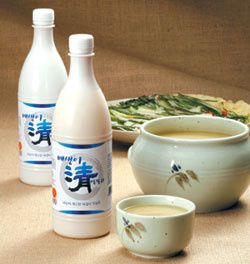
As it happens, yes, we do like makgeolli.  For the uninitiated, makgeolli (prn. MAHK-ko-lee) is a traditional Korean beverage made of fermented rice and also broken dreams.  Less dangerous than soju, more powerful than beer, and it goes extremely well with pajeon.  It's a milky white substance resembling watery sunscreen, though slightly tastier and with a worse hangover the next day.  We'd had many extensive experiences with makgeolli, some of them so amazingly pleasant that we were unable to remember them.

Our new friend led us down the bike path, conveniently in the direction we were already headed.  As we got further into the city center, the path grew increasingly crowded with families hauling camp chairs and coolers.  Before long it was so crowded that we had to dismount and push through the crowd.

"There's a million people here to see the fireworks," our friend told us.  Sure enough, this looked like every other festival we'd seen in Seoul: an impossibly thick crowd pushing past fried chicken stalls or browsing their smartphones on blankets.  There were a dozen vendors selling beondegi and, even more horrifying, a dozen more selling selfie sticks (which, if you haven't had the pleasure, are telescoping rods you use to take a selfie from a greater distance).

"Do you want to stop here and watch the fireworks?" he asked over the din.  We looked at the crowd, then back at our ludicrously loaded bikes.  "Or should we maybe go a little further?"  We agreed to sacrifice a better seat for the fireworks in order to get a few more cubic inches of breathing space.

 At last, we arrived at a 7-11 located at the far end of the river island, Yeouido.  Our friend disappeared into the store while we improbably leaned our bikes against each other, and he came back out with three bottles of makgeoli.

Over the course of the conversation, we learned many things about our friend, Beom Jin (including, eventually, his name).  Sixty-one years old and embarrassed to be so, retired and not terribly happy about it, he lives in Seoul with his wife and three adult daughters.  His real passion, besides biking, was America.  Over and over again he told us about how wonderful America is, how America has the most generous hearts and wisest political minds in the world.  Being the pusillanimous bleeding-heart that I am, I expressed some surprise at hearing this opinion; generally, whenever I learn something about 20th-century American history, it doesn't leave me feeling that USA = #1.  But no, Beom Jin assured us, he knows how great America is: when he was a child in the '50s, he told us, and his family and friends had nothing, it was America and no other country that gave them food and clothing.  It took me awhile to settle down and keep my mouth shut -- I got some opinions about America -- but in the end, I learned something about Korea that I'd always half-known.  Regardless of the US's motivations for intervening in Korea, regardless of some of the nasty stuff that went down in the name of fighting Communism, to Koreans of a certain age, America is the veritable cat's PJs.

Of course, this newfound knowledge didn't last very long before disappearing in a milky white cloud.
 "Hey, it's 7:00, the fireworks should be starting," Beom Jin said.  We craned our heads back the way we came, and sure enough, if you squinted hard enough, you could see distant flashes of red and green flickering through the trees.  A little disappointed by our poor view of the show, we turned back to our conversation.  By 7:10, the fireworks were over.  It was good to know that, of the million people in Yeouido that night, we almost definitely had the best time that night.  Though probably the worst time the following morning.

And then Jenn fell asleep on the sidewalk while we looked for a motel.  But that is a story for another day.

Monday, October 24, 2011

I Am the 2.4% (Of the 1.22%)

So much of the news of the last 2 1/2 years has felt like something out of a dream, stories or fantasies that only exist on the Internet or the occasional English-language newspaper that I pick up: nobody here talks about the obstructionism of the Republicans or the economic crisis in Europe, and if they did, I wouldn't understand a word of it.  Pretty much the last news to come out of America and land over here was the death of Michael Jackson, which they still can't stop talking about (I have 7-year-old students who can Moonwalk).  I have a small group of gaijin coworkers and friends, of course, but most of them hail from places other than America -- according to a reputable source, Americans make up just 2.4% of the gaijin population -- which certainly broadens the conversation, but I don't hear all that much about American politics.  My only political involvement here consists of talking about the Daily Show with my Canadian coworker and talking about the news with Jenn (which is awesome, though we do tend to read the same articles and blogs).

The last month has been a hard time to be so cut off from what's going on Stateside...If I weren't here in Japan, I would be Occupying Wall Street or any other available thoroughfare I could find.  I'll spare the blogosphere a rehash of the typical laundry list of middle class liberal complaints -- others have said it a lot better than I would be able to --

Click to enlarge enough to read the whole thing.  Seriously, do it, this is awesome.

--suffice to say that I think the OWS movement will be my generation's defining moment that will finally get the damn Boomers off our backs about getting off the couch and fighting the power already. I consider myself an ideological hippie through and through, but I've got enough of a pessimistic streak that I honestly never thought a movement like this would come along; I assumed that the only angry mobs I'd be seeing in the newspaper were Tea Partiers waving guns and complaining about how hard it is for white suburbanites in the richest country of the history of the world (I mean, think of the unreasonable burden of income taxes they're being made to pay!  No group on earth has ever been persecuted this way except for everyone in the history of fucking civilization.  *Ahem*  End digression.)

In fact, one thing that (perhaps unwisely) defuses my rage at the Man is the knowledge that, like the Tea Baggers, I am one privileged motherfucker.  Not the Man himself, perhaps, but one who has benefitted from His doings...a Manling, if you will, or a Manlet.  As a white, heterosexual male, I've never had to face discrimination based on my origins or appearance; I'm 100% free of debt; I've gotten an awesome liberal arts education and two degrees for free.  In short, what do I have to complain about?  I guess it's typically been the privileged folk spearheading revolutions in the past, from the landed slave-owners at the original Tea Party through to all of the non-privileged non-white participants in Second Wave Feminism who had to remind the most prominent members of their movement that they and their mothers had been in the workplace for generations out of necessity.  In any case, it's a bit of a schlep to Occupy KC or StL, so I'll do the absolute minimum for the cause and...talk about Japan? Sure.

Returning to the idea of privilege, I really think that I've traded one privilege for another by coming to Japan.  On the one hand, I'm comfortable here, treated very politely by one and all, safe from the scary job market in the States.  I'm afforded some special treatment: I don't have to work the ridiculous hours my Japanese coworkers do, and I don't have to pretend that I have no desires other than doing my job satisfactorily.  On the other hand...


...This is an ad for my school's Halloween Party.  The line at the bottom reads "Gaikokujin no sensei to asobou yo!"  Pretty much translates as: "Come and play with our foreigners!"  I'm a token here.  A novelty for my curly hair and skin tone.  Part of the "Gaijin Zoo," as a friend of mine puts it.

The thing is, I can live with it.  But then, I signed up to be here; people who are subjected to this kind of fetishization or disenfranchisement in the US (and they are many) are being done wrong.  I'm a minority here, with a lot of the attached negative baggage, but I get that special treatment, too.  Some gaijin here make it their life's mission to fight this kind of divisiveness, as previously mentioned.  More power to them (if that expression makes any sense under the circumstances) for fighting the good fight. I'm not invested enough in living in Japan to put too much of myself into changing this country, nor do I really feel like I have the right to as a temporary resident (though I did march in the Kansai Rainbow Parade last year).

As it is, I'm kind of struggling with what my responsibilities are as an expat.  Is it enough to send in an absentee ballot every couple of years?  Do I have a duty to try and make Japan better for guys like me, who tend to have it pretty great everywhere already?  Is there more I can be doing to thwart the plans of the Owners in the US from over here?

Aw, who am I kidding?  By next year the Republicans will make sure absentee (Democrat) ballots are trashed or prosecuted for voter fraud.

Monday, November 29, 2010

Fight the Pawaa

I've recently become aware of a fierce activist here in Japan named Debito Arudou, an American-born university professor in Hokkaido who became a naturalized Japanese citizen in 1996. He's garnered quite a reputation here as a gaijin-defense activist: protesting Japanese-only establishments, helping foreigners know how to deal with discrimination, all that jazz. Here's his website.

I've heard some pretty conflicting stuff about this guy, which makes it pretty hard to form an opinion. In his own words (well, word), he's written "hundreds" of essays about the experience of the foreign-born or non-racially-Japanese Japanese citizen. In short, as previously mentioned, it's tough for anyone who lives in Japan who doesn't look Japanese. It's even worse for someone who wants to make their life here, who marries a Japanese citizen and wants to do seemingly simple life tasks like get a driver's license or own a home. And yes, this goes even for people of racial groups that Westerners think look Japanese -- Japanese citizens of Chinese or Korean ancestry get a ton of shit here. So on the one hand, I'm all about this Debito guy inasmuch as they take away my liberal card if I don't dig human rights activism.

On the other hand, though...well, after reading more than one of his articles, he comes off as awfully entitled, don't you think? I mean, can you believe it? A heterosexual white man being denied preferential treatment, having to undergo some frustration before getting service at a restaurant or onsen? Tragic! Additionally, one of my coworkers has given me another perspective on the "No Foreigners" bathhouses in Hokkaido: essentially, there are a lot of onsen (public baths) in the North that get visited by Russian sailors semi-frequently. Every time the sailors visit, they trash the place, break a lot of the equipment, vandalize buildings, and intimidate everyone in town. So, recently, those establishments have decided to only serve Japanese customers. My coworker believes that, while racism isn't exactly the shiniest practice in the world, in the case of these onsen it's a way to protect their business from being ruined by a group that has repeatedly proven itself untrustworthy. Not sure what I think about this one myself...

I also wanted to see what you all out there thought about this article by Debito that sprang up a few months ago. Again, seems a little harsh, but...well, honestly, I agreed with pretty much all of his points. On the commuter train in the morning, I see students drilling advanced vocabulary words for upcoming English tests, words like mandate and utility, but in my experience these same students are probably incapable of having anything but the simplest of conversations in English. Without repeating any unfounded rumors, I will say that the JET Program has been under fire in Osaka lately, largely because of the ineffectiveness of bringing over untrained twentysomethings to teach English. But this is why I'm so fond of Debito's central point that JETs aren't meant to be good classroom teachers, they're meant to give their students the experience of interacting with foreigners. I've seen that smile of relief when Japanese shopkeepers realize that I can speak a little Japanese and that I'm not going to wreck their day. I've seen that same smile on old ladies on the train when we share a few simple words of complaint about the weather. Jenn and I can regularly see the look of amazement on a student's face when they hear that we have problems with things like reading our mail or buying groceries, that expression of "Wow, I've never thought about how your life might be different from my own. Crazy!" In short, I think we're both doing something generally positive for the world by being here. Still, is it fair to write off an entire country's culture of teaching as ineffective and imbecilic? I mean, it's not like the American school system is all that great, either, right?

I'd love to hear what any of you in the Web-o-tubes have to say about this guy's article(s)! Flame on!

Wednesday, October 27, 2010

Not Since the Deliveryman Called me Harry Bellafonte...

Yes, yes, the concert last Saturday went well. Lots of fun, even if it was a little tense because about half of our audience (5 of 11 people) were musicians, meaning they probably could catch it when I screwed up. Still, one guy was enthusiastic enough to ask for three encores, and we had a nice little session time after the show where the audience came up to play a few numbers. And we played one more, too.

Before the show, we had a rather interesting encounter with a Japanese man whose name escapes me (not an uncommon phenomenon) who seemed keen on America to the point of...well, oddity. A few of his points (as best I could understand them) are here enumerated (and no, I really didn't make any of these up):

1. Japanese people are all very short compared to foreigners.

2. Japan has way more homeless people than America does.
2a. Furthermore, Japanese homeless people are ugly and smell bad.
2b. By contrast, American homeless people are certainly all attractive.

3. Japanese people cannot grow facial hair well.
3a. Foreigners, who can grow excellent facial hair, all look like Charles Bronson.

It's really refreshing, especially after some recent nastiness, to confirm that even the people who really like America still have no idea what foreigners are actually like.

Tuesday, October 12, 2010

Promoting Intercultural Harmony Through Suckiness

There's this thing, we have it sometimes. It goes away for long periods, but it always comes back, usually at inconvenient times. Stop me if I get too technical here.
I'm referring, of course, to culture shock. Those of you guessing "body odor," "bedbugs," or "Foreign Accent Syndrome", better luck next time. We were warned about culture shock early and often before coming over here -- a JET alum in Kansas City drew us an intricate diagram that Jenn dutifully copied down, here reproduced for your illumination:
Ha ha, butt.
The term "shock" is really a bit of a misnomer; it captures the depth of the feeling, sure, but "shock" implies a sudden jolt that is over quickly, like jumping into a cold pond or getting an injection, while culture shock is more of a long-term recurring stress that haunts the sufferer for a long period of time, like drinking Pancake Drink.

"What brings this to mind?" you may ask. "Why now, why today, did something happen?" Quiet down and I'll tell you. Last week at work, we were tasked with a unique responsibility: removing the water from a muddy field by hand so 150 children could march on it. Yes, friends and relatives, we were given the job of cleaning mud. By "we," of course, I am referring to teachers-in-training, junior teachers, and anyone else who couldn't find something else to be busy with fast enough.
I could glorify it, I really could. I could explain how important this job was, how vital to the well-being of the kindergarten and the safety of our children it was to soak up puddle after puddle with huge sponges. I could wear my mud-soaked shoes (and pants, and shirt) like a badge of honor, knowing that I put the good of others ahead my own comfort. I would do that in a heartbeat if I had any idea why the higher-ups decided this task was at all necessary or, you know, possible.
The reasoning was straightforward if laughably impractical, provided by the shrewdest managerial minds that didn't have to do it themselves: keep the kids from getting too dirty while we're rehearsing for the Sports Festival. Never mind that the first part of the rehearsal would be performed in the Hall (which is, you know, indoors). Never mind that the actual Festival will be held on another school's grounds. Never mind that the sun was coming out or that simply walking across the field produced still more muddy springs, even after half an hour of mopping.
It was when I was carrying my third bucket full of dirt from one end of the playground to another -- a literally Sisyphean task, covering wet dirt with dry dirt that immediately became wet -- it occurred to me that my career had taken a turn for the strange, and after mentally preparing a new resume, I started to linger on the Culture Shock "W." Ankle-deep in mud, I tried to calmly put my feelings in a point on a chart, a natural byproduct of living with a culture different from my own, and not an unquenchable rage that burned inside me like a thousand suns. If a group of teachers in the U.S. had been ordered to do a task like this, the day wouldn't end without at least one resignation, firing, or lawsuit. And while I'm not exactly the most well-informed guy in the world (room), I can safely assume based on meetings with fellow expats that shit like this wouldn't really fly in the U.K., Canada, Australia, South Africa, or France.
Here, though, it's just kind of...what you do. It's the reason the Japanese teachers stay here until 8:00 or later every night, even if they don't have work to do. It's the reason we buy souvenirs for every one of our friends, neighbors, relatives, coworkers, and house plants. It's the reason we foreign teachers attend meetings even if we don't understand a word of what is being said, even if we have nothing to contribute and can't benefit in the slightest from being there. It's the reason land meant for everyone shouldn't be used by anyone. In short, it's Just What You Do, and it kind of sucks.
If we were to look for one thing about Japanese culture that makes life difficult, this would be it; even if circumstances differ in individual cases, even if no one either wants or needs to go through with it, everyone does what is expected of them. If the boss isn't leaving until 7:30, who the hell are you to decide that it's important to leave earlier? If someone decides that every school day should start with the students greeting the principal (who's not in the room at the time), then that's what we do; if it's decided that it's important to start the day with standing on one foot and quacking, you'd better believe that will be followed to the letter. If someone decides that the mud is too muddy, then we grab those sponges and get to it.
Now, I really don't want to give the impression that the Japanese are about blind loyalty or obedience or anything slanderous like that; really, I'm not trying to be racist here, and I'm not trying to claim superiority or assign negative qualities to an entire nationality. Hell, people in the States do some pretty shameful things to keep their jobs, and especially in this recession, pride is something most people can't afford in the workplace. What I'm trying to get at, however clumsily, is that the pressure to do what is best for the group rather than what an individual wants or feels is very, very strong. It's one reason Japan is so amazingly well organized: teamwork is incredible over here, and I've seen it inspire my students in downright heartwarming ways (a group of boys getting competitively involved in a worksheet to encourage a discouraged classmate). Hell, it's how Japan makes great cars. It's just a cultural force that involves a fair amount of obnoxiousness and...well, mud.

Career opportunities, the ones that never knock.

"How do you say 'mendokusai' in English?" asked Enamoto-sensei, lifting a bucket of dirt.
"This sucks," I offered. Mike thought it over and slowly enunciated, "Pain in the ass." The teacher tried it out, tasting each syllable.
Another teacher, one covered in mud, looked up and asked, "What's 'daiten ma-ma' in English?"
I looked to Mike, who laughed. "Good enough." The teachers looked impressed. I snickered; "Good Enough" is the English Team motto.
It was kind of a beautiful moment, really, and it was reassuring to know that my coworkers, the ones who had grown up following what they were expected to do, still got kind of cheerily pissed off about having to do an annoying job. Or, as Mike put it very eloquently, "Nothing brings people together like having to suck it."

Monday, October 4, 2010

Racist, Racister, Racistest

Last week, when we were strolling down Midosuji as we are wont to do (hey, karaoke isn't going to come to us), we heard music, a sort of bouncy, cheery march, floating between skyscrapers and down alleyways. We smiled at each other; it was a nice day, the first Sunday of autumn, and the music added a lightly festive air to the sunny weather. We could hear some lyrics in the vaguely Japanese-sounding tune, but hell, we can barely understand slow, perfectly enunciated Japanese, so understanding lyrics is still at least a decade of study beyond our abilities. We held hands. I wondered if I was being paranoid or if passersby really were giving us more nasty looks than usual...

Then the loudspeaker kicked in at frightening volume: the only words we understood were "Amerika," "gaijin," and "Nippon" (meaning "Japan," but with nationalistic connotations). And then we saw, rounding the corner of Shinsaibashisuji, the Crazy Racist Van, decked out in Japanese Battle Flags and illegible (to us) messages that we could only assume are jingoistic slogans.

It wasn't much of a demonstration, but then, it never is. We've seen this sort of procession before, always on a weekend or national holiday, never more than a dozen or so people, always in the same area around Midosuji, one of the biggest streets in Osaka. The most we've seen is a couple of trucks with a parade of silent, headband-wearing, flag-waving middle-aged dudes (always men); the least was the unaccompanied Racist Van.

I'm not really qualified to talk about the extent or severity of racism in Japan; I'm just a dude who happens to live in a country. So, in the spirit of journalistic circumspection, I will limit this post to stuff that has happened to me, to Jenn, or to anyone we happen to know. Or...anyone we've heard of. Plus here are some links. Information in the fifth person or less, is what I'm saying.

A couple of friends of ours just took their Japanese driving tests for the third time; the first, they failed because they failed to wear dresses and make-up (they're women, that is probably a relevant fact). This last time, it was because one of them crept out at a stop sign to look each way before proceeding (for shame!). Each time, they say, they have words with a group of cheerful gaijin who are taking the test for the fourth or ninth or eleventh time. I know, I know, it must be because white people are such terrible drivers. Even if that weren't the case, though, word is that they fail each time for a similarly made-up-sounding reason -- too far to the left, too far to the right, too slow, too fast, too close, too far, etc. The ultimate conclusion that most of them came to through laborious application of the scientific process: they don't want gaijin driving, so they find reasons to fail them.

Having exhausted my anecdote and my other anecdote, it's time for the conclusions! Once again, I'm not saying that Japan is more racist than the U.S. or anywhere else. Kirksville, MO was home to one of the biggest names in Neo-Nazism in the Midwest, and he was an extremely vocal minority indeed, but he was representative of Americans in the same way that Spider-Man is representative of New Yorkers. Japan has a reputation for dealing with race differently than the U.S. does, but shit, so does everywhere else. We share a large part of our history, culture, and language (well, pretty much) with Australia, and look what came out of there last year to riotous applause:

If you ask me, it says just as much about how easy it is to entertain Australians as it does about race relations.

I guess what I'm trying to say here is: it's interesting being put in a situation that I have heard about and read about my whole life, but never experienced in the first person (well, second person). I'm certainly glad that my first foray into discrimination is in a country where most people are far too polite to speak to strangers even of their own race...though it would do wonders for my liberal self-righteousness to be able to speak of my own struggles with conquering racism; as it is, "one time I saw a truck that was racist" is so little hardship that sociopathic white supremacists would be unimpressed by my plight.

Wednesday, July 14, 2010

The Amazing Race

We've only had a few visitors to our place here in Osaka...OK, one (Steve. Hi, Steve!), but every one of our visitors has gone through the same process of adjustment that we did ourselves. After about a week in Japan, we reach a shocking, inescapable conclusion: "Holy cow, everyone here is Japanese!"

I realize we're not dealing in Pulitzer-quality reporting with this one, but it's something that takes a lot of getting used to, especially when you've grown up in a country as racially heterogeneous as the United States. Not that I deserve to pat myself on the back too much for that one -- I mean, West St. Louis County is about as white a place as you'll find in the U.S., second only to Kirksville MO (I met Kirksville's black guy, he's nice) -- but the important thing is that we were brought up with the assumption that we would eventually be interacting with members of other races besides Non-Hispanic Caucasian. There are several taboos you learn growing up in a racially-sensitive culture like the 21st century US, among them "don't generalize across an entire race," "don't assume things about cultures you don't understand," and perhaps #1, "don't do impersonations of other race's physical mannerisms or accents." Oh man does that go out the window after a few days in Japan.

In general, in the States, when you see any given person on the street, you tend to make the assumption that they are American. I realize this may be different in states with a greater influx of immigrants than Missouri or Kansas -- say, some kind of fictional, highly hyperbolic Orwellian state in which police and citizens were legally mandated to harass and demean people of Hispanic descent at every opportunity -- but until we hear someone speak, we have no way of knowing that they didn't grow up just down the road. Even if they're wearing a dashiki, sari, or viking helmet, they're still pretty likely to be an American in touch with their cultural roots.

Not so in Japan. A person of Western ancestry can grow up in Japan, understand Japanese culture, and speak accentless Japanese, but on the subway everyone, Japanese and foreigner, will assume that they are a tourist, a visitor, a gaijin. Which, of course, means that all of this nasty avoidance applies. In Japan, advanced grammar is defined around the in-group and out-group, and membership in the in-group is pretty much limited to Japanese people who look Japanese with only extremely rare exceptions. One of my coworkers at the kindergarten is married to a Japanese woman and has three biracial children, none of whom speak English. He laughingly told me about how whenever his 5-year-old on is asked "Are you a foreigner?", he bugs his eyes out and replies, "AAAAAAHHHHH!"

I'm not saying that Japanese race relations are bad or wrong (I would be expelled from the ranks of academia and Stuff White People Like if I did anything so culturally insensitive), just that people can say and do things that would be considered unacceptable in the U.S., stuff that I could never live with for more than a few years. At a meeting at work last week, this same coworker (whose Japanese is perfect, who has lived in Japan for the last 14 years, who has worked at this school for 5) was complimented for 10 minutes by the administration for translating a memo for the foreign staff. This happens at every meeting. Likewise, a Korean-American coworker is always introduced to parents and students with these two stunning facts: 1. he looks Asian, but he's not actually Japanese, and 2. even though he's Korean-American, he doesn't like kim chi! (The room erupts with people humming "Eeeehhh?", the national sound of impressed surprise). Just imagine how well this would go over at an assembly where the principal shockingly told the student body that their head teacher, Mr. Ramirez, doesn't like tacos.

Here's a fairly high-profile instance of this kind of institutionalized...let's call it racial insensitivity: meet Mr. James, McDonald's Japan's mascot for much of last year:

Cute, ain't he?

Mr. James loves McDonald's. Like, a lot. He's a dorky white guy who keeps a blog all about how much he loves McDonald's. In fact, to promote a line of "Big America" burgers, he appeared in advertisements all over subways, buses, and train stations proclaiming his love of Japan and of McDonald's, always only in katakana. I know we've gone into the difference between katakana, hiragana, and kanji before (trust me), but in short, katakana is used for borrowed words only. Communicating solely in katakana would mean acting like an illiterate, ignorant buffoon. The best analogy I've read would be if, to advertise a line of Asian food, McDonald's in America featured a schoolbus-yellow, kimono-clad Japanese man saying "Me likee McFlied Lice."

I guess to be fair, I'm a gaijin, I'm dorky, and I speak pretty terrible Japanese. But still, it's a rather unwelcome (if interesting) inversion for a white bread liberal like me: here, I'm not the majority, I'm not considered just a regular ol' guy. Here, I'm the oppressed, forgotten minority, the overlooked intrusion on other peoples' good days. Here, I'm the guy who gets to be offended by racially insensitive ads and TV depictions. Here, I'm considered exotic because I have curly brown hair without the use of toxic chemicals!

Remember, Japan is a culture based around preserving the wa -- the harmony of a setting or situation -- and to this end, people stay quiet, don't speak to strangers, don't dress appreciably differently from their peers or fellow subculture members, don't eat in public (this one's a sore spot), don't break the rules, don't make eye contact, don't sing in public, don't chew gum, don't talk on the train. Jenn and I violate the wa just by standing in a room, even if if we follow all of these unwritten rules.

For a more informed perspective on race in Japan (i.e., one containing actual facts), check out this article from the New York Times.

Wednesday, May 12, 2010

One Nation Invisible

I'm very excited to report that, in my time since coming to Japan, I have mysteriously developed a new...well, there's really no other word for it...superpower. Yes, as an ability I now share with the rest of my race, enjoyed only under the proper environmental conditions -- like the amazing neotony of salamanders, like the Kryptonian susceptibility to the rays of Earth's yellow sun -- I now enjoy the power of invisibility. Unfortunately, those of you familiar with the greater film oeuvre of Kel Mitchell should understand when I say that my newfound power tends to work only under the right circumstances. Example:

A few weeks ago, I was late for the bus. Not too late, not irresponsibly late, but late enough that I was running (brief sidenote: I don't run well. Like most Althoff men, I have a sleek, aerodynamic physique more suited for activities like poker and human cannonball). I was keeping up my best wheezing pace when I spotted the bus, still waiting at the station. I relaxed, slowing to a canter and digging some change out of my pocket as spots danced on the edges of my vision. Still 10 meters or so away, the bus closed its doors with a lurch. It took off, and so did I, stifling my urge to cry "NOOOOO!" I sprinted (more or less) after it, waving furiously, finally thinking to start yelling "Sumimasen! Chottou matte kudasai!" I kept pace with the driver for nearly a minute; when I was just about ready to collapse, he turned his head and met my eyes. I forced a manic smile ("Never Stop Smiling" is but one of the many interpersonal skills I've learned in Japan) and started to slow to get in the rear door...then promptly ate exhaust as the bus zoomed by. I used the last of my breath to call the driver something vulgar and, in retrospect, pretty redundant.

I really couldn't have been that hard to spot -- a big, messy-haired gaijin in a bright green sweater, huffing and puffing and waving and yelling and sweating tends to be more than a little conspicuous -- so you can see why I've settled on the invisibility theory. It's either that or a psychocultural phenomenon known (to me) as Foreigner Blindness or FB, estimated (by me) to affect about 1 out of every 1 Japanese people.

Essentially, when an afflicted Japanese person spots a gaijin near them, their visual cortex begins blocking certain visual signals that would cause them distress, replacing this sensory input with something more reassuring and easily ignored, like a vending machine. My research suggests that this effect stems from an almost paralyzing fear that they will be called on to speak English. See illustration:
Image C and R Krazy Krow, a fine and upstanding gentleman of the sort would never have objections, legal or otherwise, to casual appreciation and reuse of his work.

Indeed, when I approach bus drivers or shop attendants, as soon as I open my mouth they often shake their heads and make an X with their fingers in an effort to ward me away, never mind that my question is in Japanese. This is a country that enjoys a 1:1 customer-to-clerk ratio, yet as soon as I need to ask a question about purchasing goods with my hard-earned yen, employees in a 10-meter radius scatter like startled deer; important matters develop in the back room, merchandise demands immediate reorganization, everyone decides it's time for their lunch break. Ha ha, I'm just kidding. As far as I can tell, Japan has yet to develop the concept of a "lunch break."

Why this crippling Anglophobia? The country is stuffed to the gills with conversation schools and cram schools...English education is clearly big business over here. You can't throw a brick in downtown Osaka without hitting half a dozen gaijin who are here to teach English or die trying. English is absolutely everywhere, on the radio, on TV, on menus and business names...almost everything that isn't just written in English has a Japanified spelling of it (most medical clinics say both "clinic" and "クリニック," pronounced "kurinikku").

Most puzzling of all, pretty much every Japanese person under the age of 50 has taken at least three years of English class in high school, and many have taken much more. For perspective, this is the same length of English language study that is mandated in Sweden, and the average Swede has an infinitely better grasp of English than the average Japanese person. Hell, the Swedish Chef has an infinitely better grasp of English than the average Japanese person. All right, that might be a little unfair, but to test my hypothesis/blatant racism: go to Stockholm, stop five strangers on the street, and ask them if they can direct you to a bus stop. Now try the same thing in Tokyo. How did everyone do? Odds are, in Stockholm at least four people will be able to answer in near-perfect English, while in Tokyo you'll be unable to get anyone to stop and answer.

Thursday, April 22, 2010

Ye Olde Kinge's Englishe

I love the British. Seriously, I love London, I love the beer, I love the comedy. I love the music so much that I don't even mind that they improved on something (rock and roll) that is rightfully the cultural property of America (in that it came from music stolen from people that we went to all the trouble of enslaving). I love the culture of politeness. I love the witty, largely unattractive celebrities.

That said, I've been getting pretty pissed off (or "brassed off") by British expats over the last several months. I realize that there's a fair amount of class tension in the US, and anyone who tells you otherwise is trying to get you to vote Republican (or, I don't know, "Tory"). But class rivalry/hatred/discrimination/hilariously stereotyped comedy is a time-honored, openly-acknowledged tradition in the UK; it's what sets aside your Delightful Urchin Chimneysweep from your average Timothy Dalton or Alfred the Butler. By demographics, only about 10% of British people speak with an accent classy enough to be allowed on the radio. But hey, that's their business, right?

The problem is, over here in Japan there are far fewer British people to bear the brunt of this snobbery. Here, many of the British expats I've met have busied themselves with trying to convince the whole world that there's only one kind of English that is, you know, proper and correct and stuff: the King's English. I've been turned down for interviews at two conversation schools because, as an American, I don't speak the King's English, I speak something barely recognizable as language at all.

I realize that American English and British English are different, sure. We say happy, they say chuffed; we say bullshit, they say bollocks; we say color, they say colour. I mean, really, "flavour?" Ha ha, what in tarnation does that mean? They might as well be speaking Martian!

The thing is, I'm generally a big enough person to say that we're speaking two different Englishes. American English isn't the correct form of English. Neither is British English. Yet there are teachers over here who give impassioned, long-winded speeches about how horribly we're miseducating our students when we teach them to say anything other than "all that and a packet of crisps."

One of my predecessors at Harumidai Yochien was apparently given to snide little comments about this: according to one of my coworkers, she told the room, apparently out of the blue, "I want some jelly." For the sake of clarification, someone asked, "Do you mean like jam-jelly, or gelatin-slash-Jell-o?" She scowled and explained: "I said 'jelly,' and I meant 'jelly.'" I guess the Brits have to occupy their time with something since the Empire collapsed and they ran out of brown people to oppress, huh?

In completely other news, I know we haven't been keeping up with the blog lately. The main reason for that (other than our complete contempt for you, the readers -- hi, Mom!) is that we're finally moving into the city! Yes, our horrible, hellish stay in the suburbs has come to a close...we're moving to Motomachi in Namba, 5 minutes' walk from several of the hippest neighborhoods in Osaka, such as Dotonburi and America-Town. As part of the moving experience, we're required to provide several dozens of sets of paperwork to the Man, which leaves us little time to reflect on life's little quirks. We will return you to your irregularly-scheduled snark as soon as we finish the moving process (say, October of 2011). Excelsior!

Thursday, April 1, 2010

The Bowing Will Continue Until Morale Improves

Despite our ramblings to the contrary elsewhere on this blog, daily life in Japan really isn't all that different from anywhere else in the developed world. People go to the supermarket, drive around to look for parking, work overtime, hang out at home on the weekends, work oh god so much overtime, and have huge parties to look at flowers or the moon (we do that in America, right?). We don't have to adjust to anything that different from our familiar routines: no landmines to dodge, no martial law, no national dress code, no tiger attacks, no taun-tauns. All said, nothing that weird about living in Japan.

With some exceptions.

There are times, though, where we might as well be living on Mars. In particular, Mars on a planet-wide festival celebrating 100 years of Martian traditions and hierarchical ritual (it shall be called Mars Days). One of the more contentious aspects of Japanese culture is the company-centered group ethos (in Jenn's words, "they start singing the corporate anthem when they're zygotes"; we used to laugh at that joke, once, if there ever was a time when we didn't live in Japan). Recently, I had a few opportunities to witness the bizarre cultish practices of the corporate world.

Since beginning this blog post, I have been notified that some of my coworkers may or may not read this blog (whee! I'm famous!), so I will expurgate any company secrets, incriminating gossip, or overtly hateful slander. Consider yourself warned.

Last Saturday, I was instructed to be at work at 8:30 for the annual meeting -- not to be confused with the daily morning meeting, the daily afternoon meeting, the monthly department meeting, the weekly morning assembly, or the semi-weekly biennial overnight motivational seminar and luau. After arriving in my best (read: only) suit and standing around obviously in the auditorium for a while, I was told that I would have to go through some preliminary practice for bowing and greetings before the meeting began. As usually happens in such cases, my gaijin dander got up. "Hey, what makes you think I don't know how to bow or say "OHAYO GOZAIMASU"? Am I stupid or something, huh?" I thought. My resentment quickly faded to anger when I saw that every employee had to practice these activities before the meeting was allowed to start.

As a group, all 100 or so employees, teachers and administrators and bus drivers, practiced yelling good morning, hello, and thank you on command. Each time we finished yelling, we bowed simultaneously, first towards the principal, then to his mother, who was sitting in for some reason. The first four or five times we tried this, the principal expressed his disapproval if not outright contempt at our collective bow. He had one of the teachers, the Specially Designated Faculty Toady, count us off; you see, for a proper bow to the kindergarten principal, you are supposed to bow at the waist, arms at your sides, feet together, stay down for "Ich! Ni!", start to straighten on "San!", and stand upright only when "Shi!" has been yelled. Confusing, I know, but bear in mind that 9/10 of the people who were being harshly rebuked have been doing this for their whole lives. On the command "rei!" (which my Japanese dictionary translates as "expression of gratitude," "command; order," or "departed soul; ghost"), we were to applaud at roughly the same tempo; on a second command, we were instructed to clap thrice in unison, thus: *clapclapclapclapclap (rei!) CLAP - CLAP - CLAP*. I have seen presidents sworn in with less fanfare than this. Nations have been founded with nowhere near this level of organization.

It was around the third rehearsal run-through when I realized: wait a minute, I've seen this before. Teachers correcting a crowd of people, teaching them to bow correctly and yell "hai!" when their name is called? Sweet jumpin' Buddha, this is exactly how they treat the kindergartners!

Still, we had to put on a good show. Everyone was there, after all, in their best suits, ready to impress. Never mind that the only people who would be at the meeting were already there for the rehearsal, including the principal and his mother. Eventually, after more effort than was put into my grad school graduation (hell, more effort than my thesis, for that matter), the meeting began. I had hoped that, with my limited Japanese, I would be allowed to sit quietly, not follow along, and get in some good, productive thinking about food, but the principal singled me out to have a fluent coworker translate everything for me. It opened with the teachers reciting in unison (but of course) the Five Principles of our school/parent company. No, I can't tell you what they are. Use your imagination.

Next was the simultaneous reading aloud of some kind of story. By virtue of my status as an illiterate, unwashed barbarian, I was exempt from following along, which was fine by me, as the only thing I understood was the title: "Tomodachi ga iranai" (translation: "You Don't Need Friends." Seriously. Unemployment was looking better and better). This was followed, in no particular order, by the Mission Statement, the Future Plan, the Five-Year Plan, and the Principal's Dream, the last of which included such tidbits as paying every teacher 100,000,000 yen annually and taking all the teachers to Disneyworld. One time I had a dream where I fought crime with Rowdy Roddy Piper. True story. My translator whispered to me that the Principal's Dream has been pretty much the same for at least 14 years; with a recurring dream this chronic, I would recommend that our Principal consult a qualified psychotherapist.

Despite all the rehearsal, things went disastrously during the bowing and receipt of certificates. One teacher, a young woman who has probably studied for years for this privilege, had her posture forcefully corrected by the Vice Principal while she was standing on stage in front of all her coworkers. Another had to repeat her bow three times. I was agape; in the States, making an employee do this kind of shit would end up in a fist fight or a lawsuit, surely. Still, I guess this must be how they make such good cars, right?

In short, this meeting was important enough to practice seven or eight times and to publicly deride employees' posture, but not important enough not to interrupt to publicly deride employees' posture or mock their names (incidentally, the Principal looked down at my certificate and saw fit to give me a new Japanese name, "muzukashii..." ("difficult...")). All that was left to do was to let our hair down and party! The welcome party, held at a nearby hotel, was a blast, though considering the posturing, debasement, drink-pouring, and general buttsniffery that went on, I'd say the only thing missing from Japanese office parties is actually using employees as furniture. The school's founder did make friends with one of the bus drivers, though...they both got drunk and yelled a lot, occasionally sharing a Bogart/Raines BFF glance.

Monday, March 22, 2010

King of All Fruits

Bali travelogue, blog-exclusive postscript: One of the most doggedly frustrating dimensions of Japanese culture (ask any gaijin) is omiyage, which roughly translates as "souvenirs," though that falls pretty short of the full horror of the situation. Basically, anytime anyone goes out of time ever for any reason and any length of time, they are expected to bring back something representative of that place for everyone they know. Some gaijin have detailed spreadsheets covering what omiyage to get for whom in what size and/or flavor. Jenn and I, being less dedicated acquaintances and coworkers, picked up a bag of candy at the airport. Ordinary there wouldn't be anything too horrible about this (I understand the international airport in Tokyo has souvenirs from most East Asian cities for last-minute omiyage crises), but we made the poor decision to get candy that tastes like durian fruit.

Abandon hope, all ye who enter here.

For those of you who don't know, durian fruit is the end result of the evolutionary attempt to produce perfect catapult ammunition. It's a huge, clearly inedible, grenadelike object that looks like it should hatch into a cave troll or perhaps a Predator. Think of it as a Dire Pineapple, if it helps. For some reason, it has a reputation for being an exotic delicacy, though its secondary reputation is for stinking like a diaper in July. I should note that we had not tasted durian before bringing back a processed chemical version of this barfworthy fructodemon.

My coworkers at the kindergarten barely bothered for feign excitement for this horrific visitation. My supervisor smiled and went, "Oh...durian...um...king of fruits!" The candies have been sitting in a bowl, untouched, for days now. As far as I know, I'm the only sap clueless enough to try one; not only did it taste like ass with an aftertaste of onions and notes of old socks, but even opening the plastic released a cloud of semipermanent stink into the room, like unsealing a tiny magic lamp that, instead of a genie, contained farts. I did get some of the children to try some just before I left the room, though. I heard cries of "Dame! Dame!" ("Bad! Bad!") follow me down the hallway.

I did apologize to my follow teachers for bringing such a terrible, smelly curse on their heads. Mike, the senior gaijin at the kindergarten, said buoyantly, "Are you kidding? This is like the best thing you've ever done!' It's good to know that, no matter how well or badly I do my job, no matter what I accomplish at Harumidai Kindergarten, I will forever be known as The Guy Who Brought the Ass-Flavored Candy.

Jenn has reported that the bag of candies she brought to work mysteriously vanished after only one day. They work quickly at her school, I guess.

Friday, March 5, 2010

Fun Fun

Disclaimer: I realize that I failed to meet last week's mission of blogging every day. However, my 3/5 success rate falls only slightly short of the Meat Loaf Not Bad Statistical Threshold (.667), so I don't feel too bad about it.

This is Harry Althoff, award-winning* reporter for "Amazing Tales of the Gaijin Patrol," blogging to ou live from Harumidai Kindergarten. Well, live, minus any time difference and low-pressure zones, accounting for temporal distortions caused by any resident tachyon fields in the troposphere (god damn those tachyons). A few isolated scenes from my first three days of work:

1. Within two minutes of walking through the front gate, a small child punched me in the butt. A premonition of things to come?

2. I'm not sure why, but all of the children in the international classes have been given English names. Let me tell you, it's kind of a mindf*** to be in Japan, faced with Japanese children who are speaking Japanese and still hear the names "Brandon," "Jack," and "Sophia." Coincidentally, one of the kids has the nickname "Harry." Boy, did he get a kick out of meeting me. I spent the next hour being approached by one or more of his classmates who were each in turn hit by the amazing idea that they just had to should out loud, usually in Japanese: "Wait...your name is Harry...and *gasp* his name is Harry!" They would then rofl vigorously.

At lunch, I had a fascinating conversation with a group of 5-year-olds, conducted half in English and half in Navajo (OK, Japanese, fine):

Lil' Harry: My Japanese name is Haruki.
Harry: Oh, cool!
Student A: What's your Japanese name?
Harry: Me? I don't have a Japanese name.
Lil' Harry: Heeee? (in English, "Whaaaaa?")
Lil' Harry, Student A, and Student B begin frantically discussing what my new Japanese name should be.

This was probably the most earnest, interesting discussion I've had with anyone since coming to Japan. Hell, since I was in kindergarten.

3. Wherever I go here, people are happy to see me. Yeah, I get stares, I get people whispering about me and pointing, but that's no different than the reaction anywhere else in Japan. At Sakishima, there was only one person who was ever happy to see me (bless you, Momoe), but here? I've known these kids for three days, and already I get delightful squeals when I enter a room. At least five students have run, yelling, down a hallway to hug me. Or...y'know, punch me in the butt. Either way, more enthusiasm than I ever saw in high school. Though I wasn't thrilled when that one kid filled my pockets with sand.

4. I must have made a really good impression at my interview, because according to the interview files that were lying around (seems to happen a lot when I have nothing to do at work), I was more qualified than fellow applicant Wallace Shawn. Cue 5 minutes of Princess Bride jokes.

5. When a few older kids were playing around with nonsense rhymes of the word "candle," they found themselves laughing and chanting the word "kancho." Within half a second, the teacher, Marty, immediately started a new activity. "We don't like that word around here," he explained. When another teacher who missed it asked what they had said, he leaned in and whispered, fearful of invoking the dread power of the hated word.

That's mostly it so far. More observations and reportage to follow. Of course, not next week, as Jenn and I will be doing important research in


We'll be researching...I don't know, sand. In

*Least Interesting Award recipient of the Nobody's Heard of You Award. I have a statue and everything.

Wednesday, February 24, 2010

Stick to Guessing Weights

An important part of living abroad is learning to reexamine your snap judgments that you rely on for daily life; for example, if I were to purchase some ice cream at the grocery store, I may not be able to trust my inherent assumption that something marked "Ice Cream" would not contain any tentacles or moving parts. One of the things that's hardest to get used to is probably our complete inability to accurately guess the age of anyone in Japan.

This is no big secret, really. When I accompanied Jenn to the Jet Alumni Association meeting in Kansas City, they separated the men and the women for gender-specific talks. I can only imagine the things covered in the Lady Talk, but I can only assume from the last time there were organized Man Talks and Lady Talks that it was something about flowers and bees (also, that mocking a teenage girl about menstrual issues will cause her to develop telekinetic superpowers and slay an entire high school class). The man talk entailed athlete's foot, some extremely self-satisfied discussion of the size of Japanese condoms, and a caveat that any attractive woman a gaijin male will hit on will be at least 40 years old. Ask any gaijin: when judging the age of a Japanese person, subtract at least ten years from whatever you assume at first.

For instance, just look at the Japanese Minister of Defense (right).

Scientists are at a loss as to what causes this effect...whatever it is, it's probably related to the fact that the Japanese also do not sweat. Hell, maybe it's prolonged exposure to Hello, Kitty. It could be something in the air (plastic?), though, as some of the gaijin I've known to live here for five or more years also seem to be immune to the effects of aging. Whatever the case, I've learned that some Japanese people can be somewhat touchy about this subject, taking intended compliments about their youthful appearance to mean that they look "childish." I'll just be careful when dealing with my new boss next week:

I believe he has three children.

Friday, February 12, 2010

Apocryphanalia

Well, we're in the height of the holiday season here in Japan: the last post-Setsubun parties have died down, and yesterday was Foundation Day, a traditional day for staying home from work and, I don't know, inspecting the foundation of your house for silverfish or seepage or something. Whatever. But the Early February Holiday Season is far from over. Some people think that Japan does not celebrate Valentine's Day. Some people are fools.

A dramatization of Japanese romance.


The specifics of Japan's observance of Valentine's Day, at least in the Kansai region, are actually very interesting. In the mid-sixteenth century, before entering a period of national seclusion, several small Christian missions sprung up on Japan's shores; many of these missions were established by brothers of now-obscure monastic orders (you know, like the kind that keep cropping up in terrible Tom Hanks movies). In 1629, thousands of Christians were executed by the Tokugawa shogunate after the shogun expelled all foreigners from Japanese soil -- but, importantly, not from artifical islands such as Dejima in Nagasaki. Though Christianity was nearly eradicated at this point, some underground traditions were carried through the subsequent centuries on such artifical islands, including the esoteric practices of the French Order of St. Valentine. Currently, many Valentine's celebratory practices held over from Renaissance France are still observed in Kansai regardless of religion: on February 14th, Osakans nearly without exception meet in community "High Courts of Love," where volunteers hold mock "court" for crafting "love contracts" and hearing offences of love such as betrayal and frigidity, while local poets submit traditional rondeau and ballades to woo the objects of their affection in a highly stylized, romantic, and spiritual environment.

...Nah, just f***ing with ya. It's pretty much the same old orgy of commercialism and chocolate that they have everywhere else on Earth. The only difference is that over here, the women give chocolate (giri-choko or "obligation chocolate") to the men (and we wear shoes on our hands, cats and dogs living together, etc. etc.). Of course, men have to return the favor in March on White Day, a holiday my Japanese textbook defines as "yet another gift-giving holiday." In the meantime, here's to candy given unabashedly out of social obligation!

Had you going there, though, huh?