Showing posts with label Holidays. Show all posts

Friday, December 9, 2011

The Haps

Hey!  How's it going, Internet?  Been awhile, huh?  Boy, I can't believe it's been a month since we rapped last, huh?  Seems like almost yesterday.  Well, let's see what all I can catch you up on...

The JLPT has come and gone without too much fanfare.  I think it went a bit better this time, but we won't know until February; the test's grading process is a very time-intensive, highly subjective one that requires many weeks of careful consideration.  WEEK ONE: RUN SCANTRON SHEET THROUGH COMPUTER.  WEEKS TWO THROUGH EIGHT: COFFEE BREAK.

The holidays have been as full of workplace-mandated merriment as ever. The Christmas party was last Friday, and again I was passed up for the role of Santa Claus. Instead, I was given the part I've played a dozen times before as Two-Term President Emeritus of the Truman State University RPG Club: Elf. When I was tasked with getting "Santa Claus" to the door past the horde of children when our part of the pageant was over, I realized that Santa keeps elves around for more reasons than simply making toys; there were moments were, had I not intervened, children would have trampled each other into a festive red paste just to touch the hem of Santa's coat. I was convinced we weren't going to make it out alive for at least a minute or two.  And what would the holidays be without a good healthy fear of death?

Additionally, I've introduced the wonders of Hanukkah to a new generation of bored 8-year-olds, though it took a bit of doing: I had gotten as far as, "Hannukah is a Jewish holiday" before hands shot up.  "What's 'Jewish?'" asked Wesley (stupid nicknames, remember?).  "Juice?" Kyle asked.  "Chewing gum?" guessed Justin. After I calmed everyone down, I explained: "Jewish means 'Yudayajin.'"  I so dislike using Japanese in the classroom, but this was a case that couldn't really be handled with pantomime.  I patted myself on the back for bothering to look up the word before and dispensing with this matter effectively so we could move on.

Wesley rose his hand again.  With surprising fluency, he asked, "How do you say Yudayajin in Japanese?"  Oy.

Our band, Raku 3, has been taking off lately, in a manner of speaking.  We've been playing about one concert a month at local dives, all free shows (though we do pass around a hat when we remember to), all pretty well attended.  There exists a bootleg CD of one of our shows, and come the new year we were considering recording an actual album.  Readers of this blog, you all have a standing invitation to any and all future shows, though for now they'll all be in the Osaka area.  Please enjoy these photos of the kind of horrible places in Osaka's ghetto where we play (+50 points to indie cred!)


Raku Three, the venue's proprietor, and four of our fans (well, three and one old guy who wanted to be in the photo.)

 Other than all that, we're just gearing up for our travel plans this Christmas!  We were going to take advantage of our strategic geographic placement to make a move on Australia, take in some sun and some much-needed ambient English.  Sadly, though they look pretty close together over on this side of the globe, it turns out it's still a 10-hour flight to Sydney, and thus, it costs about as much as it would to just fly to the States.  Fine, we decided, we'd go wherever we could fly to for cheap from here...Thailand!  Vietnam!  Taiwan!  The Philippines!...are all out of our price range.  Taking the ferry to Okinawa, our next plan, got as far as reading about the area, reserving accommodations, and buying ticke--SERIOUSLY, THAT MUCH?  The latest plan, then, is to take the ferry to South Korea, which we'll attempt to do up right for the holidays.

Expect something hilarious about Christmas in Japan sometime later this week (though really, at this point in our third year here, anything hilarious about life in Japan is starting to wear a bit).  This is H-Bomb and Jenny Dreadful, signing off!


Wednesday, November 2, 2011

Hella Ween

I came to Japan for many reasons: adventure, excitement, fabulous prizes. I did not come here to get paid to make children cry -- that has always been, at best, a side benefit. However, for the last week, a large part of my duties has been to devise cost-effective ways to terrify children into screaming puddles of fear. For you see, we have just concluded the most important season of the ESL teacher's calendar, a holiday as long as Lent, as meaningful as Sweetest Day, as not-getting-you-out-of-work as Columbus Day, and as fun as all three put together: Halloween.

I should point out that I have grown to absolutely loathe Halloween over the last few weeks. By my count, I have had to work at least 300,000 Halloween parties in the last week and a half alone. That plus an entire month of Halloween crafts, Halloween games, Halloween vocabulary, Halloween picture books, and Halloween songs is enough to make a hardworking English teacher run screaming for the unemployment line.

Speaking of: one of the biggest Halloween affairs at the kindergarten is converting Ahiru class into an お化け屋敷, a haunted house. As you might imagine, this is a complex transformation, involving many hours of moving furniture as well as liberal application of black felt and crappy, almost certainly toxic faux-spiderwebs.


Also: haunted broccoli!

For the 2- and 3-year-olds, we keep it pretty mild: lights on, no spooky music, no masks, no jumping out from behind lockers. As you might imagine, they took it rather well. A rough transcript of Yamada-sensei taking Donuts class through the haunted house: "Ooh, wow, spidaa! 見て、見て, ske-re-ton! Oh, look, Harry-sensei! Goo mohning!"

For the oldest kids, however, we pulled out all the stops short of buying more materials. Scary music and sound effects, dropping or throwing dummy vampire bats, a clip from "The Ring" on a loop, the whole 8.229 meters. Having been volunteered for haunted house detail (rather than the just-as-frantic Pumpkin UFO Toss, Mystery Box, or Bat Fishing), I opted to reprise my role from last year as Hand Grabbing At You From Under A Table. I'd like to think that I gave a decent performance--I did the whole bit, knocking on the table, shaking it, growling, etc. etc. Really a classic interpretation of GRR I AM A MONSTER AND I WANT TO EAT YOU.

By and large, I was met with three reactions from the children. The first and most common was a kid being taken aback, then laughing and saying something along the lines of "Oh, it's Harry-sensei. Hallo!" (This is what's known as the correct reaction). The second was, predictably, wailing, tears, screaming. No peeing, thankfully--I've learned that children seem to pee in response to boredom, not fear.

The third and most immediately distasteful reaction was kicking. A lot of the older kids, especially the boys, have had their natural fear responses (and common sense, and social skills) replaced with an all-purpose urge to bellow, "Orra! Monster! I will fight you!" and unleash their 3 feet of fury on the presumed Bad Guy. The more well-mannered ones restrained themselves and just spent the whole trip through the haunted house proclaiming, "全然怖くない!", or, "I'm not scared at all!" These boys accounted for 30% of the kicks that I got from under the table--the other 70% were performed by a single boy who went through the haunted house at least three times for the single purpose of wreaking furious vengeance upon any animate or inanimate object that happened into his field of vision. He punched every prop and every teacher at least once. These are the children they get to star in condom commercials in other countries.
No known photo exists of this kid, as he moves far too fast to be captured on film. Please enjoy this visual approximation.

At one point, Ahiru room's glass door was broken, a spiderweb of glass far scarier than the fake ones within the room. It has not yet been determined if it was broken by the 2nd category of children in panic or the 3rd in rage. This did illustrate for me the important role that a haunted house plays from an educational standpoint, however. I'm not one to enjoy the screams of children (except for a couple of children in particular); one of the 6-year-old girls would only go through the haunted house bawling, clinging to a teacher's torso like a terrified koala, and screaming how terrified she was. My soft side (admittedly, my largest side) felt for her...after all, I hate scary movies, I never went to a haunted house, I ran screaming out of movie theaters during the scary parts of "Temple of Doom" and "Independence Day." Why should we make kids go through such an unpleasant experience? Just for yuks?

No, I think I've just finally reached that stage of adulthood where I understand the meaning of Luke Skywalker's trial at the tree on Dagobah: as humans, we need to know how we respond to fear, and we need to practice being afraid so we can deal with it throughout our lives. The Harumidai haunted house is an extremely safe environment for children to experience a fear response -- when it was finished, some kids flat-out denied having been afraid, some realized with relief that it was just the teachers in masks, but the kids I respected the most were the ones who admitted that they had cried but now had clearly calmed down. If nothing else, the smarter kids learned that the things they saw couldn't actually hurt them, and that ghosts, mummies, and disembodied werewolf hands aren't things to really be feared.

After I finished the school's final party last Saturday (a multi-stage affair that ran from 9 a.m. to 6 p.m.), I was far too full of Halloween spirit to do anything but go home and collapse; there were parties aplenty on the town that night, but I couldn't take so much as one more "Boo." Wake me when it's Guy Fawkes Day.

But first, for your viewing enjoyment, a selection of adorable pictures of children in Halloween costumes. Enjoy!


Awww, right? Brief tangent about Halloween costumes: I'd imagine the most popular costumes here are pretty similar to the most popular ones in the states. Lots of Transformers, lots of princesses, a smattering of Spider-men (Spiders-man?). Probably #1 for the girls was Fresh Pretty Cure (basically Sailor Moon), and #1 for the boys would be Goseija (the show Power Rangers was stolen from...yep, it's still running). The only real cultural difference here would be that a lot of boys were dressed as witches, too, with the hat and everything. Seems "witch" isn't quite as gendered in Japan as it is in the States. Go fig. Anyway, back to it:


And here's what I looked like while taking all of these pictures. Even when my last reserves of enthusiasm for Halloween have run dry (which takes about 20 minutes), my enthusiasm for pirates is boundless.


Monday, February 7, 2011

In the Name of Conglomerated Soy, Demon Come OUT!

Yes, the weather is turning, the gleeful bacchanalia of Groundhog's Day is past us, which means that it's time once again for that greatest of all holidays: Demon-Bean-Banishing Day!

Just in case you don't happen to remember the traditional practices of Setsubun (for shame!): on February 3rd, which is the lunar New Year, a family will gather at home or at a nearby shrine and fling dried soybeans at a designated family member wearing a demon mask. While doing so, they're supposed to shout "鬼はそと!福は内!", or "Demons out! Good luck in!" In addition, everyone is supposed to eat a number of beans corresponding to their age. Are you sensing a theme here?

Since I'm employed at the kindergarten this time around, I'm in a little better position to see how this fascinating holiday is celebrated by its core demo. And "demo" is absolutely the right word here, as it turns out! According to my cooking instructor -- a man just old, ornery, and Japanese enough for me to believe absolutely anything he says -- Setsubun is more or less made up by the relevant corporations, in particular by Big Soybean. I know, it's horrendous that such a pure celebration of faith and...I don't know, joy or something can be exploited by greedy industries. The practice of throwing beans at demons does go back a few centuries, but it's exploded in the past 30 years thanks to big advertising pushes from the soybean conglomerates.

Worse, the tradition of eating makizushi was entirely invented about 20 years ago by grocery stores! The thing that gets me about this is just how wholeheartedly I bought into the entire affair. I mean, every year on a Medieval demon-themed day, you're supposed to face a special compass direction as determined by Chinese geomancy and eat an eel roll? Of course! You can't make that shit up! Unfortunately, as it turns out, someone absolutely did make that shit up.

Still, I can't let the Man get me down. Nothing to do but try to enjoy and terrify:


This photo was picked from hundreds taken by my coworkers, and is unique among the roll in that there are no crying children in it. The vice principal, a lady whom I will only describe as "classy" as long as I am employee of Harumidai Kindergarten, gave an introductory Setsubun speech to all the students. As she did so, the kids were quietly equipped with a small pouch of dried beans. Here's an excerpt from the beginning of the talk (keeping in mind that my Japanese is not yet on par with a 3-year-old):

"So, children, it's been very cold lately, right? And maybe you've been feeling sick lately? Well, that's because of demons. There are demons in your house and school." Fun, yeah? Is this really the sort of thing you should be instilling in kids?

Then, two of the bus drivers jumped out in masks and tiger-print loincloths (called onipantsu, or "Demon Underwear"), wielding huge clubs and yelling at two hundred odd children. Hence the crying. I think this is one of the beloved childhood rituals that is way, way more fun for the adults than the kids, and thus is remembered and cherished by each generation so they can visit its horrors upon the next.

Then the vice principal invited the demons on stage to announce their conquest and introduce the laws of their new regime to the children.

On an unrelated note:


No idea why, but the "Digital TV" monster was absolutely everywhere, including a 5-foot-tall version at the kindergarten. I had come to the conclusion that it was for parents who were opposed to Digital TV and wanted to drive it from their homes. A friend tells me that it may just be one more reminder for Japanese adults that analog broadcasts will be ending soon. And hey, not a bad way to remind people; if memory serves, they tried absolutely everything else to let people know about the digital switchover in the States.

Sunday, December 12, 2010

Christmas Comes to Osaka

This is what I did last night (click to play, double-click to make it bigger):


Please ignore the out-of-tune cello playing. We'll be Stateside from December 17th, so if you're around the KC or StL areas for the next few weeks, give us a shout! Oh, and Merry Christmas.

Monday, December 6, 2010

Happy Chaka Khan!

Happy Hanukkah, everyone! I trust your Hanukkah season has been going well, full of plenty of festivity, all the traditional Hanukkah songs and decorating and parties and TV specials? How was your Hanukkah shopping? Boy, the malls sure get crowded with shoppers looking for last-minute Hanukkah gifts around now, huh?

In an effort to bring multiculturalism and novel international experiences to the children of Osaka (instead of my usual grin-and-wait-out-the-clock strategy), last Wednesday I planned and executed a Hanukkah lesson plan for Free School, our two-hour after-school program for first through fourth graders. And when it comes to fostering multiculturalism, I think I can say with some confidence that it was at least as successful as Pirate Day or Water Cycle Day! Honestly, it warmed my heart in a way that I didn't think Hanukkah was capable of.

"Don't be a schmendrick," I urged Kaito when he was teasing his sister. And you know what? He stopped.

While planning this lesson, I didn't give much thought to my status as half-Jewish. I guess I never have, really. I've always considered it sort of a membership card, entitlement to bust out Yiddish words or get offended by anti-Semitism or feel entitled to cook some good old fashioned Jew Food, but only as long as there isn't anyone more actually Jewish in the room. That's about it, though; I've been the most Jewish person in the room for the bulk of the last few years mainly because of my recent choice of rooms in decidedly Goy neighborhoods (Kirksville and Japan). As I recently wrote in a story I've been working on, I was Kirksville's only Jew in the same way that Bill Clinton was called the first black president. I'm Jew enough for the food but not the god, for the dreidel but not the synagogue, for the paranoia but not the guilt, for a half-hearted Hanukkah right next to the Christmas tree. In fact, I was unaware until I happened to look it up that Free School Hanukkah Day was being held on the actual first night of Hanukkah.

And you know something? I never really liked Hanukkah that much. It could be that I'm just a bit biased since Christmas was the main winter holiday celebrated at my house, but there just didn't seem to be much to Hanukkah. No Hanukkah TV specials, only the one Hanukkah song in English, and ultimately a pretty lame miracle. Which fit well in with our minimalist celebration, actually: spin the dreidel, eat some latkes, light the menorah, then forget about it and go watch TV. I feel pretty bad for the Jewish kids for whom Hanukkah has to compete with their friends' Christmas. And I'm not the only one who feels this way, it seems.

Anyway, the reason I bring all of this up is that I didn't really give a lot of thought to planning out our Hanukkah activities. The English Team considers any Free School that ends to be a successful Free School, so I put about as much care into the Hanukkah celebration as I did Pirate Day; make a dreidel you can stick on a pencil, play Hanukkah Hangman or something, have them color pictures about the story of Hanukkah and read something aloud, maybe let them light a candle, boom, done, two hours finished and I'm on the bus home. Usually the kids are pretty rowdy, occasionally disparaging of our choice of lesson plans, but as long as they make at least a passable attempt at doing the work, it's good enough for me.

But to my amazement, something happened that I can only describe as a Hanukkah miracle. The kids quietly did their coloring and rehearsed their sentences with gusto. When we dimmed the lights and had them come up to recite the story of Hanukkah and light the menorah, they were positively spellbound, and when all 8 candles were lit, the "HAPPY HANUKKAH!" they shouted brought a tear to my eye. Then, since we can't leave candles burning all night in Star Class, we instituted the new tradition of circling the table and blowing the candles out on the count of three. All 14 students quietly sat in a big circle and played dreidel without cheating, without crying, and without punching one another. When we gave them each a doughnut ("HANUKKAH DOUGHNUT, PLEASE!"), they all clapped their hands together and shouted "Mazel tov!" before eating.

"Are you getting verklempt?" my partner asked me when I started to get a little misty. I was. I had had the best Hanukkah ever. And I walked away with a new appreciation for my people's (well, half of my people's) traditions and a brand new stereotype: Japanese people fucking love dreidel.

And now, for your enlightenment, the story of Hanukkah, uncolored but festive nonetheless. Written by Harry Althoff, illustrated by Google Image Search, performed by the Harumidai Kindergarten Wednesday Free School Program. Try to imagine a small Japanese child reading these lines (or, if possible, find a small Japanese child to read it to you).


Hanukkah is a Jewish holiday in December.


On Hanukkah, we play games and give presents.


A long time ago, a bad king took away the Jewish temple.


There was a very bad war, and the Jewish people won!


When they got back to the temple, there was no more oil for candles!


But the candles burned for 8 days! It was a miracle!


On Hanukkah, we light 8 candles. It's called the Festival of Lights.


Let's enjoy Hanukkah!

Tuesday, November 30, 2010

Further Adventures in Shameless Plugs


Yes, once again those wily Raku Three are performing at Raku Cafe (what are the odds?), this time for your Christmas/Hanukkah/New Year/Kwanzaa/Emperor's Birthday festivities! Anyone and everyone is welcome for good vegan food, good beer, good music, and good company! Come and deck our halls...for free, no less!

See the flier for directions to Raku Cafe. Hope to see you there!

Monday, November 8, 2010

The Chronicle of Punch-sama and Judy-hime

Last week, as I'm sure you know, was Culture Day, during which we engaged in all the usual Culture Day activities (still waiting on some of those Culture Day cards to arrive, guys, no rush). I believe the theme of this year's Culture Day was...Culture. So, aside from the typical, run-of-the-mill Culture Day BBQ, Culture Day Flower Viewing, Culture Day Bagel Bake-Off, and Culture Day Bowling Marathon, we also attended a performance at Osaka's National Bunraku Theater for the third time.

What is bunraku? Come on, don't play that game. Fine, if you want to do it this way: bunraku is traditional Japanese puppet theater, developed in Osaka in the 17th century and closely tied to the theatrical traditions of kabuki.


No, not that kind of puppet.


No, think paler, creepier, more...y'know, Japanese-looking.


Agh! No!


There we go. It's generally a good time, though the show does require some intimate knowledge of Japanese theatrical conventions, mythology, geography, history, and domestic culture to understand. Oh yeah, and classical Japanese. Or, alternatively, you can fork over 600 yen for an earphone guide. Since we only had a week to prepare to go to this show rather than the requisite 40 years it would take to learn all of that, we paid up.

Bunraku is fun times, all said. Each puppet is worked by three puppeteers, all of whom appear on stage covered entirely in black. At first, it seems like the stage is crowded with people playing with dolls, but by the end it's easy to ignore the puppeteers entirely and see the puppets as the only figures on stage (somewhere in between it's kind of like the puppets are being attacked by ninjas). The whole thing is narrated by a single reader (swapped out with other readers between scenes) who sings every character's lines from behind a podium; the effect, though powerful, made me wistful for when I too used to play with action figures and do the voices myself. There was no showmanship like drinking glasses of water or whatnot, though at one point a puppet tossed something to another puppet across the stage to riotous applause. Also, there was a samurai duel on the beach that moved progressively closer, represented by using increasingly larger puppets. CGI, Schmee-GI.

I'm not really sure what I can tell you about the story of the plays we saw: reading the plot summary in the program, things seem pretty action-packed, with plenty of daring sword thefts, murder-suicide pacts, beheadings, samurai showdowns, and conspiracies...also, at one point a spy masquerading as an old stone mason kills a samurai by throwing a chisel across stage (sadly, this was accomplished by the performers by having the puppet being hit by an apparently invisible chisel, then falling over). As is the case with most Japanese theater, though, these deceptively simple set pieces are filled out with pausing for every character to stop and describe exactly how they're feeling at any given moment, how sad something makes them, how sad they are about what happened in the last scene, and occasionally how sad they are at the transient nature of existence or something.

I wish I could tell you a little more about the plot of the first play, if only to demonstrate just how long these damn things can be, but I'll keep it to the interesting (non-beheading) part that gave me the most pause: at the end of a lengthy duel between samurai of two rival clans and hashing out the repercussions of that duel, it turns out the protagonist and his son conspired for the son to switch places with the illegitimate son of the Emperor so the hero could kill his son and get the Emperor's son smuggled off to safety. It's never really established how any of the characters know that this young samurai is the (again, illegitimate) Prince or why some characters really care about that and others don't, but apparently it was completely necessary for our hero to sacrifice his beloved son to save the Prince even when nobody thought that was important before head-chopping-time. The Japanese teacher we saw the show with said she understood that part, even if she didn't think she could ever do such a thing. Go fig.

I'll leave you with this last little tidbit: the last play of the evening was translated as "The Red-Hot Love of the Greengrocer's Daughter." Sadly, the title proved to be the most exciting part of the story.

Friday, July 16, 2010

Happy ________________ Festival!

This week there was a big festival at the temple behind our house. I asked the vendors which festival it was, and they all just pointed at the temple, so I guess it's this temple's annual festival. Here are some photos I took, just to give you a taste of festival season life in Japan (click to see them bigger):


I don't know how I can sleep at night with that thing right in my backyard.

There were about 3 different goldfish stands at this festival. Catching goldfish is something that Japanese adults reminisce about so fondly.


And now, some of the festival food: cucumbers on sticks, corn, and yakisoba. The yakisoba guy kept messing with me, telling me it was expensive and asking if I could afford it. He was clearly not feeling the spirit of the somethingorother holiday.

And last, Harry and Anpanman, the only cartoon character who gets his superpowers mostly from being edible. Really.

The pictures will get better as soon as I get a lens that can actually open up wide enough to let in some light at nighttime.

Thursday, July 8, 2010

Love-Crossed Stars

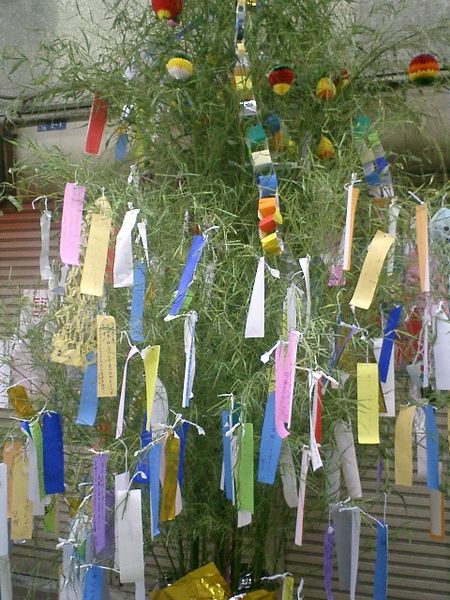
Happy (belated) Tanabata, everyone! American or Japanese, Christian or Jewish or atheist or agnostic or Rastafarian, whatever your religious or cultural traditions, I think we can all come together and enjoy a festival commemorating the annual convergence of Vega and Altair.

Apparently not enough of the kindergarteners wished for pleasant weather (which is, ahem, the traditional wish, OK?), because it rained like a mother here yesterday. Which, appropriately enough, drenched all of their paper wishes that we tied to bamboo shoots. It's OK, half of them were wishes to become goseija (Power Rangers) or Pretty Fresh Cure anyway. Also, in the picture cards we used to tell the students an English version of the Tanabata story, one of the pages said nothing but "Hikobuta was a Japanese cowboy." Man, why don't we have any American holidays that involve cowboys?

Jolly Star Festival, everyone!

Friday, February 12, 2010

Apocryphanalia

Well, we're in the height of the holiday season here in Japan: the last post-Setsubun parties have died down, and yesterday was Foundation Day, a traditional day for staying home from work and, I don't know, inspecting the foundation of your house for silverfish or seepage or something. Whatever. But the Early February Holiday Season is far from over. Some people think that Japan does not celebrate Valentine's Day. Some people are fools.

A dramatization of Japanese romance.


The specifics of Japan's observance of Valentine's Day, at least in the Kansai region, are actually very interesting. In the mid-sixteenth century, before entering a period of national seclusion, several small Christian missions sprung up on Japan's shores; many of these missions were established by brothers of now-obscure monastic orders (you know, like the kind that keep cropping up in terrible Tom Hanks movies). In 1629, thousands of Christians were executed by the Tokugawa shogunate after the shogun expelled all foreigners from Japanese soil -- but, importantly, not from artifical islands such as Dejima in Nagasaki. Though Christianity was nearly eradicated at this point, some underground traditions were carried through the subsequent centuries on such artifical islands, including the esoteric practices of the French Order of St. Valentine. Currently, many Valentine's celebratory practices held over from Renaissance France are still observed in Kansai regardless of religion: on February 14th, Osakans nearly without exception meet in community "High Courts of Love," where volunteers hold mock "court" for crafting "love contracts" and hearing offences of love such as betrayal and frigidity, while local poets submit traditional rondeau and ballades to woo the objects of their affection in a highly stylized, romantic, and spiritual environment.

...Nah, just f***ing with ya. It's pretty much the same old orgy of commercialism and chocolate that they have everywhere else on Earth. The only difference is that over here, the women give chocolate (giri-choko or "obligation chocolate") to the men (and we wear shoes on our hands, cats and dogs living together, etc. etc.). Of course, men have to return the favor in March on White Day, a holiday my Japanese textbook defines as "yet another gift-giving holiday." In the meantime, here's to candy given unabashedly out of social obligation!

Had you going there, though, huh?

Wednesday, February 3, 2010

Happy Bean-Related Winter Holiday!

Happy Setsubun! As I'm sure you know, today is the day when all of Japan welcomes the new season (which I can only assume is Winter, Pt. 2) by eating sushi rolls and throwing beans at each other. You knew that, right? I mean, duh.

It's an occasion for great festivity, no different from the equally weird-ass Roman Feast of the Lemures. Family members put on demon masks and are pelted with hard, inedible beans by their relatives who chant rituallistically to drive out the demons and usher in the good luck. And it's not creepy at all!

Not even a little.


I'm celebrating by taking the day...well, actually, I do still have to work today. Two jobs. Yes, even though Japan has about three National Holidays per month, Bean-Throwing-Demon Day is considered of lower national import than Sports and Leisure Day. But I guess I'm observing it by working even less hard than I usually do. Also, I got a bag full of myserious objects from the school, some wrapped in plastic, most bean-shaped. I would try my luck at eating one but for the fact that I overheard two of the teachers discussing the contents of their identical bags (and for once, the meaning was clear enough that I could follow the conversation):

Teacher 1, holding up a red Jawbreaker-shaped object: "Hey, can you eat this thing?"
Teacher 2: "I don't know. I only ate the candies shaped like Anpanman."
Teachers 1 and 2: (Laughter)

So from all of us here in the Gaijin Patrol, may your demons go out and your luck go in. Beans on earth, etc.

Saturday, December 26, 2009

I Got You this Blog Post!

On the twelfth day of Christmas, my dependent visa gave to me...

Twelve dressed-up gravestones...


Eleven weird-ass ice creams...


Ten sticks of incense...


Nine unearthly portals...


Eight empty dishes (+2 stomachaches)...


Seven blurry revelers...


Six degrees Fahrenheit...


Fiiiiive raaavenous deeeeeer...


Four tiny oranges...


Three festive gaijin...


Two kimono'd ladies...


And a candy shaped like a fish!


Happy belated Christmas, early New Year, or entirely on-time Kwanzaa, everyone!