Showing posts with label Kindergarten. Show all posts

Wednesday, January 25, 2012

Mochi Mochi

A quick interlude in the Korean vacation account, brought to you by the letter N (for Not enough time to sort through our millions of photos):

Late last December, I was party to what is apparently a time-honored kindergarten tradition called Omochitsuki.  You guys know mochi, right?  It's that delicious (if flavorless) gummy rice cake that you can sometimes get stuffed with red bean paste or ice cream at Japanese restaurants -- adding ice cream makes mochi far less traditional but much, much more worthwhile as a dessert.

This stuff.

Anyway, apparently it's something of a tradition to round up a school's parents, make them take a day off from work, and impress them into service as mochi chefs.  The result, while extremely laborious, is something pretty interesting for the kids: they get to see they rice that they washed cooked, then mashed by their fathers into a paste.  Then...that's about it, actually.  That's mochi.  Behold the fearsome might of the fathers of Pudding class!


...And the kids of Donuts class take a whack at it, too.  Cuuuute.


The only thing of note that really happened at this thing was the amusing English of Ace's father: when asked if he was tired after swinging around a big hammer for a few minutes, he flexed and replied, "NO, MUCH POWAA."  Awesome.

Additional kindergarteny note: please join me in my illiteracy and check out how I made the school's webpage!  Well, the vice-principal's blog, anyway.  In the post about the English teachers.  At the bottom.  Woo!

More or less, my caption says that I am skilled at ukulele, that I am one of the Fun Fun English teachers, and that I am playing hockey with some children.  All true.

Next time: back to Korea!

Friday, December 9, 2011

The Haps

Hey!  How's it going, Internet?  Been awhile, huh?  Boy, I can't believe it's been a month since we rapped last, huh?  Seems like almost yesterday.  Well, let's see what all I can catch you up on...

The JLPT has come and gone without too much fanfare.  I think it went a bit better this time, but we won't know until February; the test's grading process is a very time-intensive, highly subjective one that requires many weeks of careful consideration.  WEEK ONE: RUN SCANTRON SHEET THROUGH COMPUTER.  WEEKS TWO THROUGH EIGHT: COFFEE BREAK.

The holidays have been as full of workplace-mandated merriment as ever. The Christmas party was last Friday, and again I was passed up for the role of Santa Claus. Instead, I was given the part I've played a dozen times before as Two-Term President Emeritus of the Truman State University RPG Club: Elf. When I was tasked with getting "Santa Claus" to the door past the horde of children when our part of the pageant was over, I realized that Santa keeps elves around for more reasons than simply making toys; there were moments were, had I not intervened, children would have trampled each other into a festive red paste just to touch the hem of Santa's coat. I was convinced we weren't going to make it out alive for at least a minute or two.  And what would the holidays be without a good healthy fear of death?

Additionally, I've introduced the wonders of Hanukkah to a new generation of bored 8-year-olds, though it took a bit of doing: I had gotten as far as, "Hannukah is a Jewish holiday" before hands shot up.  "What's 'Jewish?'" asked Wesley (stupid nicknames, remember?).  "Juice?" Kyle asked.  "Chewing gum?" guessed Justin. After I calmed everyone down, I explained: "Jewish means 'Yudayajin.'"  I so dislike using Japanese in the classroom, but this was a case that couldn't really be handled with pantomime.  I patted myself on the back for bothering to look up the word before and dispensing with this matter effectively so we could move on.

Wesley rose his hand again.  With surprising fluency, he asked, "How do you say Yudayajin in Japanese?"  Oy.

Our band, Raku 3, has been taking off lately, in a manner of speaking.  We've been playing about one concert a month at local dives, all free shows (though we do pass around a hat when we remember to), all pretty well attended.  There exists a bootleg CD of one of our shows, and come the new year we were considering recording an actual album.  Readers of this blog, you all have a standing invitation to any and all future shows, though for now they'll all be in the Osaka area.  Please enjoy these photos of the kind of horrible places in Osaka's ghetto where we play (+50 points to indie cred!)


Raku Three, the venue's proprietor, and four of our fans (well, three and one old guy who wanted to be in the photo.)

 Other than all that, we're just gearing up for our travel plans this Christmas!  We were going to take advantage of our strategic geographic placement to make a move on Australia, take in some sun and some much-needed ambient English.  Sadly, though they look pretty close together over on this side of the globe, it turns out it's still a 10-hour flight to Sydney, and thus, it costs about as much as it would to just fly to the States.  Fine, we decided, we'd go wherever we could fly to for cheap from here...Thailand!  Vietnam!  Taiwan!  The Philippines!...are all out of our price range.  Taking the ferry to Okinawa, our next plan, got as far as reading about the area, reserving accommodations, and buying ticke--SERIOUSLY, THAT MUCH?  The latest plan, then, is to take the ferry to South Korea, which we'll attempt to do up right for the holidays.

Expect something hilarious about Christmas in Japan sometime later this week (though really, at this point in our third year here, anything hilarious about life in Japan is starting to wear a bit).  This is H-Bomb and Jenny Dreadful, signing off!


Wednesday, November 2, 2011

Hella Ween

I came to Japan for many reasons: adventure, excitement, fabulous prizes. I did not come here to get paid to make children cry -- that has always been, at best, a side benefit. However, for the last week, a large part of my duties has been to devise cost-effective ways to terrify children into screaming puddles of fear. For you see, we have just concluded the most important season of the ESL teacher's calendar, a holiday as long as Lent, as meaningful as Sweetest Day, as not-getting-you-out-of-work as Columbus Day, and as fun as all three put together: Halloween.

I should point out that I have grown to absolutely loathe Halloween over the last few weeks. By my count, I have had to work at least 300,000 Halloween parties in the last week and a half alone. That plus an entire month of Halloween crafts, Halloween games, Halloween vocabulary, Halloween picture books, and Halloween songs is enough to make a hardworking English teacher run screaming for the unemployment line.

Speaking of: one of the biggest Halloween affairs at the kindergarten is converting Ahiru class into an お化け屋敷, a haunted house. As you might imagine, this is a complex transformation, involving many hours of moving furniture as well as liberal application of black felt and crappy, almost certainly toxic faux-spiderwebs.


Also: haunted broccoli!

For the 2- and 3-year-olds, we keep it pretty mild: lights on, no spooky music, no masks, no jumping out from behind lockers. As you might imagine, they took it rather well. A rough transcript of Yamada-sensei taking Donuts class through the haunted house: "Ooh, wow, spidaa! 見て、見て, ske-re-ton! Oh, look, Harry-sensei! Goo mohning!"

For the oldest kids, however, we pulled out all the stops short of buying more materials. Scary music and sound effects, dropping or throwing dummy vampire bats, a clip from "The Ring" on a loop, the whole 8.229 meters. Having been volunteered for haunted house detail (rather than the just-as-frantic Pumpkin UFO Toss, Mystery Box, or Bat Fishing), I opted to reprise my role from last year as Hand Grabbing At You From Under A Table. I'd like to think that I gave a decent performance--I did the whole bit, knocking on the table, shaking it, growling, etc. etc. Really a classic interpretation of GRR I AM A MONSTER AND I WANT TO EAT YOU.

By and large, I was met with three reactions from the children. The first and most common was a kid being taken aback, then laughing and saying something along the lines of "Oh, it's Harry-sensei. Hallo!" (This is what's known as the correct reaction). The second was, predictably, wailing, tears, screaming. No peeing, thankfully--I've learned that children seem to pee in response to boredom, not fear.

The third and most immediately distasteful reaction was kicking. A lot of the older kids, especially the boys, have had their natural fear responses (and common sense, and social skills) replaced with an all-purpose urge to bellow, "Orra! Monster! I will fight you!" and unleash their 3 feet of fury on the presumed Bad Guy. The more well-mannered ones restrained themselves and just spent the whole trip through the haunted house proclaiming, "全然怖くない!", or, "I'm not scared at all!" These boys accounted for 30% of the kicks that I got from under the table--the other 70% were performed by a single boy who went through the haunted house at least three times for the single purpose of wreaking furious vengeance upon any animate or inanimate object that happened into his field of vision. He punched every prop and every teacher at least once. These are the children they get to star in condom commercials in other countries.
No known photo exists of this kid, as he moves far too fast to be captured on film. Please enjoy this visual approximation.

At one point, Ahiru room's glass door was broken, a spiderweb of glass far scarier than the fake ones within the room. It has not yet been determined if it was broken by the 2nd category of children in panic or the 3rd in rage. This did illustrate for me the important role that a haunted house plays from an educational standpoint, however. I'm not one to enjoy the screams of children (except for a couple of children in particular); one of the 6-year-old girls would only go through the haunted house bawling, clinging to a teacher's torso like a terrified koala, and screaming how terrified she was. My soft side (admittedly, my largest side) felt for her...after all, I hate scary movies, I never went to a haunted house, I ran screaming out of movie theaters during the scary parts of "Temple of Doom" and "Independence Day." Why should we make kids go through such an unpleasant experience? Just for yuks?

No, I think I've just finally reached that stage of adulthood where I understand the meaning of Luke Skywalker's trial at the tree on Dagobah: as humans, we need to know how we respond to fear, and we need to practice being afraid so we can deal with it throughout our lives. The Harumidai haunted house is an extremely safe environment for children to experience a fear response -- when it was finished, some kids flat-out denied having been afraid, some realized with relief that it was just the teachers in masks, but the kids I respected the most were the ones who admitted that they had cried but now had clearly calmed down. If nothing else, the smarter kids learned that the things they saw couldn't actually hurt them, and that ghosts, mummies, and disembodied werewolf hands aren't things to really be feared.

After I finished the school's final party last Saturday (a multi-stage affair that ran from 9 a.m. to 6 p.m.), I was far too full of Halloween spirit to do anything but go home and collapse; there were parties aplenty on the town that night, but I couldn't take so much as one more "Boo." Wake me when it's Guy Fawkes Day.

But first, for your viewing enjoyment, a selection of adorable pictures of children in Halloween costumes. Enjoy!


Awww, right? Brief tangent about Halloween costumes: I'd imagine the most popular costumes here are pretty similar to the most popular ones in the states. Lots of Transformers, lots of princesses, a smattering of Spider-men (Spiders-man?). Probably #1 for the girls was Fresh Pretty Cure (basically Sailor Moon), and #1 for the boys would be Goseija (the show Power Rangers was stolen from...yep, it's still running). The only real cultural difference here would be that a lot of boys were dressed as witches, too, with the hat and everything. Seems "witch" isn't quite as gendered in Japan as it is in the States. Go fig. Anyway, back to it:


And here's what I looked like while taking all of these pictures. Even when my last reserves of enthusiasm for Halloween have run dry (which takes about 20 minutes), my enthusiasm for pirates is boundless.


Sunday, June 5, 2011

Owe My Soul to the [Redacted]

Hard to believe it, but it's been an entire year since I first started working at the kindergarten. There have been times where I've thought that I could be perfectly happy doing this job for my whole life -- these would be the times where I'm getting hugged by my favorite students and getting adorable photos or pictures from them, as seen in the last post -- and then there are the times where I can't shake the urge to just bolt out of the room and announce my resignation. That's mostly just during meetings, though. Something that's been rather trying the last few weeks has been that the school has come down with a bad case of the Meetings. Morale meetings, attitude meetings, posture meetings, weekend meetings, evening meetings, meetings about other meetings. Plenty of time to sit and think about what all this was like last year.

I think one of the major differences between last year and this year is that a year ago I was still fresh from unemployment. A reason to be awake and wearing my suit? Yes please! All the general suckiness and bowing and pretending-to-give-a-shit was easy because it was novel. It was crazy, it was vaguely demeaning, but hell, it was an interesting cultural experience, right? Something I'd never done before! Now, though, after a year of seeing the same kind of ritualistic offering of one's body and soul to the company, it wore a bit thin.

As with last year, I'm not at liberty to divulge much of the meeting's contents; in fact, there was a warning by the principle that we need to discover who keeps leaking sensitive information about our Mission Plan and such to the parents, as they apparently shouldn't know this stuff. So, here are a few juicy tidbits of kindergarten intel that I'm assuming is not classified. This is the real, hand-to-Buddha educational philosophy of Enchou-Sensei, our beloved principal, as revealed to us over the course of the meeting and the pre-meeting meetings. Behold, the fuel in the kindergarten machine!
  1. Japanese children are for shit these days. They can't stand very hot or cold temperatures, probably because they're always being coddled with heating and air conditioning. And they can only pay attention for a few minutes!
  2. They're also really weak because they keep eating so much meat and wheat-based products.
  3. Japan being a wealthy country, everyone only thinks of themselves and not of others, especially in Osaka.
  4. The solution is for educators to teach their students to have good hearts, even emphasizing moral enlightenment over teaching ability.
  5. As such, the foundation of our education is to make sure our students feel that they are loved and to teach them to show that love to others.
  6. Love is expressed in proper posture and bowing. THE END.
In addition -- and I do hope that I'm not divulging any sensitive company information here -- did you realize that if you don't eat meat, your poop will be gold-colored? This was a fairly major point in our principal's yearly talks, and we heard it repeated a number of times (it came as something of a surprise to my vegetarian co-worker and me, too). To unpack this concept as it relates to the kindergarten: Japan as a culture is meant to eat rice and vegetables -> meat is more popular now, but it's not as healthy -> meat contains what we need to have a competitive, fighting spirit -> obviously we shouldn't give up meat altogether, but still, hey, gold poop.

Monday, April 25, 2011

Metchya Kawaii

Just a few pictures of what exactly I do all day and the gratitude I get for it in the form of...well, fan letters. The cute is definitely one of the perks of working in a kindergarten. Also: wuv.

A card from one of my favorite students (of course I have favorite students), Shintarou. It reads "Shintarou arigatou." When pressed, he told me that I'm the bigger face on the left. The resemblance is uncanny, no?

Shintarou again, plus his little sister, who also attends the kindergarten and also has professional-level eyebrows. On the reverse side of this new year's card (1 of 2 that I got from kids last year):

Translated: "Harry-sensei." I guess I do stick my tongue out a lot, huh?

The other New Year's card I received, this from one of my other favorites. Note the curly portrait of moi in the bottom left, plus the excellent handwriting of her name. I can only guess at the context of the picture.

A Valentine's Day card from one of my...less motivated students, Nene. She's 10. Also, she kind of sucks. This card really represents her interest in English beautifully.

Kid's Box, my group of 3 and 4 year olds from Panda class. Man, that book brought the house down.

Not sure what I'm doing here, but I keep getting kids' portraits of me in which I seem to have my arms raised. So whatever it is, I think I do it a lot.

A gift from Yasuhara-sensei, and a lovely one at that. My name was spelled "Hurry" originally, but that was easily fixed with a Sharpie.

And a card I got just the other day from my favorite girl with a lazy eye. I couldn't make any sense of the picture, nor could I get her to confirm or deny anything other than it was supposed to be me. Jenn, however, helped me realize that I am, in fact, raising my arms. Surprise! The inscription is my favorite phrase in Japanese: "Harry-sensei daisuki." D'aww.

Monday, February 21, 2011

Everybody bok bok

My kindergarten just held its nth annual recital, an affair treated with the same level of planning and ritual as the Academy Awards or a presidential visit. Teacher movements were calculated down to the minute, meetings went on long into the night, all to ensure that the annual taking-photos-of-three-year-olds-yelling-and-wetting-their-pants went off without a hitch. And it did! I guess!

Please enjoy the fruits of 4 years of English education, the crowning achievement of my teaching career (seriously, I can't think of anything more satisfying), as performed by Rainbow Class at the 2011 Happyokai:


And, as an illustration of how early education is different in Japan, how many times did you do this in music class? How much do you wish you could have?


Mind you, these kids aren't particularly amazing or disciplined outside of this activity; this class is one of the more unruly ones at the school. Maybe it's just because this is awesome and everybody loves to do it.

Tuesday, February 15, 2011

Snow Day

Sorry, no blog this week. In case you haven't heard, Osaka has been stricken by the white-hot vengeance of the season. Snow demons, what hath thou wrought?


The school buses stopped running, the city buses were about half an hour late, there was utter chaos. Teachers (not me) threw snowballs at other teachers (also not me). It got so bad that even a well-meaning gaijin couldn't take out the garbage from Activity Kids without getting thoroughly dusted.

Happy Valentine's Day, snow demons. And a hearty fuck you to you, too.

Monday, February 7, 2011

In the Name of Conglomerated Soy, Demon Come OUT!

Yes, the weather is turning, the gleeful bacchanalia of Groundhog's Day is past us, which means that it's time once again for that greatest of all holidays: Demon-Bean-Banishing Day!

Just in case you don't happen to remember the traditional practices of Setsubun (for shame!): on February 3rd, which is the lunar New Year, a family will gather at home or at a nearby shrine and fling dried soybeans at a designated family member wearing a demon mask. While doing so, they're supposed to shout "鬼はそと!福は内!", or "Demons out! Good luck in!" In addition, everyone is supposed to eat a number of beans corresponding to their age. Are you sensing a theme here?

Since I'm employed at the kindergarten this time around, I'm in a little better position to see how this fascinating holiday is celebrated by its core demo. And "demo" is absolutely the right word here, as it turns out! According to my cooking instructor -- a man just old, ornery, and Japanese enough for me to believe absolutely anything he says -- Setsubun is more or less made up by the relevant corporations, in particular by Big Soybean. I know, it's horrendous that such a pure celebration of faith and...I don't know, joy or something can be exploited by greedy industries. The practice of throwing beans at demons does go back a few centuries, but it's exploded in the past 30 years thanks to big advertising pushes from the soybean conglomerates.

Worse, the tradition of eating makizushi was entirely invented about 20 years ago by grocery stores! The thing that gets me about this is just how wholeheartedly I bought into the entire affair. I mean, every year on a Medieval demon-themed day, you're supposed to face a special compass direction as determined by Chinese geomancy and eat an eel roll? Of course! You can't make that shit up! Unfortunately, as it turns out, someone absolutely did make that shit up.

Still, I can't let the Man get me down. Nothing to do but try to enjoy and terrify:


This photo was picked from hundreds taken by my coworkers, and is unique among the roll in that there are no crying children in it. The vice principal, a lady whom I will only describe as "classy" as long as I am employee of Harumidai Kindergarten, gave an introductory Setsubun speech to all the students. As she did so, the kids were quietly equipped with a small pouch of dried beans. Here's an excerpt from the beginning of the talk (keeping in mind that my Japanese is not yet on par with a 3-year-old):

"So, children, it's been very cold lately, right? And maybe you've been feeling sick lately? Well, that's because of demons. There are demons in your house and school." Fun, yeah? Is this really the sort of thing you should be instilling in kids?

Then, two of the bus drivers jumped out in masks and tiger-print loincloths (called onipantsu, or "Demon Underwear"), wielding huge clubs and yelling at two hundred odd children. Hence the crying. I think this is one of the beloved childhood rituals that is way, way more fun for the adults than the kids, and thus is remembered and cherished by each generation so they can visit its horrors upon the next.

Then the vice principal invited the demons on stage to announce their conquest and introduce the laws of their new regime to the children.

On an unrelated note:


No idea why, but the "Digital TV" monster was absolutely everywhere, including a 5-foot-tall version at the kindergarten. I had come to the conclusion that it was for parents who were opposed to Digital TV and wanted to drive it from their homes. A friend tells me that it may just be one more reminder for Japanese adults that analog broadcasts will be ending soon. And hey, not a bad way to remind people; if memory serves, they tried absolutely everything else to let people know about the digital switchover in the States.

Monday, January 31, 2011

Forget Harder or Smarter, Work More

I've been having a hard time getting accustomed to working full-time. Blame my generation (hell, everyone else does). I know, I know, it's something that everyone has to get used to, if it wasn't work they wouldn't call it "work," a penny saved is a penny earned, cat's in the cradle and the silver spoon, I am the walrus, etc. etc. I think my problem is amplified, though, by starting full-time work here in Japan: up until now, I've worked solely as a dishwasher, a Toys R Us "associate," a teaching assistant, and a pizza delivery driver (in that order) -- all less than 20 hours per week, each one requiring little more than a pulse and a pair of pants -- and now I've plunged into the most hardcore dedicated workforce this side of the Doozers from Fraggle Rock. Or, put another way, having taken my first tentative baby steps, I've decided to skip walking and running and go straight to bareback elephant riding.

A staple of pop culture for much of the 1980s (if my old school Dilbert anthologies are to be believed) is the idea that Japan has marshaled its workers into almost superhuman efficiency. Putting aside the current state of the economy, for a long time in American business there was a struggle to be more like the Japanese. I realize this ambition has probably been dead for a long time, but let me just put it to rest for any employers in America: your employees will never, ever be as committed or loyal as Japanese employees. Ever. You can give your employees all kinds of incentives and benefits to being invested in the well-being of the company, you can hand out salary incentives and profit-sharing and overtime and benefits (none of which they do in Japan), you can copy the Japanese exactly and have your employees do calisthenics and retreats and mandatory bonding activities, but you'll never, ever conquer the fact that they will always prefer to be somewhere else. There's just something magic about employee behavior in Japan that can't be replicated elsewhere. Even if Japanese employees hate their job and everything about it, they keep that free will shit to themselves.

Of course, this has already been well documented on this fine website. But to give you a further example of the level of dedication I'm talking about, let me recreate a typical morning for your enlightenment:

Every morning, I roll into work at around 9:25, a full 5 minutes early (this being about 110% for me). By this time, the Japanese staff has already been in for...well, I have no way of knowing since I've never been more than 5 minutes early to work. I've heard that the day begins at 8:30, which is fun, since the school day begins at 10:30. I can only imagine what happens between 8:30 and the morning meeting at 9:30ish, when the fun really begins.

The morning meeting includes at least one of the higher-ups and anywhere between three and six helper teachers; I assume the classroom teachers have already done their own morning meeting by this point, because they've already moved down to their classes. Every day, a different participant is tasked with conducting the meeting, which means that she announces (shouts) what they will do just before doing it, i.e., "Now we are starting the morning meeting for January 27th!" First, the teachers recite the "Harumidai Kindergarten Affirmation" in unison. Now, my Japanese is somewhat sketchy (yes, still), but I can puzzle out the basics: "Today, Harumidai Kindergarten will become #1!" This is followed by reading a passage aloud from the official Harumidai Kindergarten teacher's book, typically a story or anecdote about friendship or opportunity or motivation or some crap. This, too, involves everyone shouting in unison. Side note: absolutely anything sounds creepy as hell when it's read aloud in perfect unison by a group of people.

Next, some issues of the day are discussed. I tune this part out, since it's usually pretty boring, but I should at least mention that there is a strict protocol for posture and body language during meetings, all of which was demonstrated in a 3-hour seminar given by our principal last year, every word of which I expect to hear again in a few months. The end of the meeting is my favorite part:

1. The meeting leader announces that the meeting is over.

2. At the top of their lungs, everyone chants, "私たちは空いている!" twice. I've had a damn hard time figuring this one out, since "空いて" means "empty" in the same sense as "my stomach is empty" or "the bathroom is unoccupied," so the teachers are essentially saying "WE ARE EMPTY!" I've been told that it has connotations of being receptive and eager, but still. Damn.

3. The meeting leader directs them to clap. Which they do, for about 3 seconds. Again, yes, in unison.

4. The meeting leader directs them to stop clapping, so they punctuate their applause with three synchronous claps, like, CLAP! CLAP! CLAP!

5. The meeting leader directs them to bow.

6. They (informally) thank each other. For...something. Clapping well? Probably for putting up with their clapping, and for helping them become as empty as they can.

As with all the bowing, the souvenirs, the frequent working weekends, the late hours (junior teachers are expected to be the last to leave), and the expectation that medical leave be accompanied by copious apologies and repeated explanations of one's illness to every staff member, the morning meeting wouldn't really fly in other places.

Of course, it's conditions like this that make Japan such an appealing place for people outside the system. This is how good cars get made. When a friend from Pittsburgh came to visit, he kept commenting on how sparkling clean Osaka is, which is especially striking because Osaka is considered one of Japan's dirtiest cities (it could have something to do with Pittsburgh, but that's neither here nor there). Why is Japan so clean? Because shopkeepers are expected to wash the sidewalk in front of their store every day. Because schools don't employ janitors since the school is cleaned every day by the teachers and students as part of the school day. Because, in short, doing shitty demeaning tasks like scrubbing tea kettles and cleaning mud is, depending on the day, part of your job, and in Japan, your job is what you do. I know that Americans do what's expected of them at their job, but I put it to you: if you showed up to work one day and it was just suddenly understood that all employees were expected to perform some new menial cleaning or organizational task, what would your reaction be? Would you protest? Quit? Grumble, at least?

Of course, on the other hand, maybe there's something to all this. Yeah, it kind of sucks for everyone with a job, but there's something to be said for destigmatizing everyday tasks, right? In the States, cleaning up after other people is something beneath us, something reserved for the invisible lower class, millions of people who sort our garbage and pick up after our kids and wash our filthy toilets whom we'd prefer not to think about. Consequently, by choosing to keep the tasks necessary to modern life secret, we push the needs and misfortunes of the working classes out of our mind, which can only contribute to the increasing impossibility of life for the working poor.

What do you think? Putting aside the whole team spirit thing that weirdly persists past high school, would it do the West some good to learn to clean up after itself? Or is too much of our life already claimed by Work to be expected to dedicate still more time and energy and dignity to our employers?

Monday, December 6, 2010

Happy Chaka Khan!

Happy Hanukkah, everyone! I trust your Hanukkah season has been going well, full of plenty of festivity, all the traditional Hanukkah songs and decorating and parties and TV specials? How was your Hanukkah shopping? Boy, the malls sure get crowded with shoppers looking for last-minute Hanukkah gifts around now, huh?

In an effort to bring multiculturalism and novel international experiences to the children of Osaka (instead of my usual grin-and-wait-out-the-clock strategy), last Wednesday I planned and executed a Hanukkah lesson plan for Free School, our two-hour after-school program for first through fourth graders. And when it comes to fostering multiculturalism, I think I can say with some confidence that it was at least as successful as Pirate Day or Water Cycle Day! Honestly, it warmed my heart in a way that I didn't think Hanukkah was capable of.

"Don't be a schmendrick," I urged Kaito when he was teasing his sister. And you know what? He stopped.

While planning this lesson, I didn't give much thought to my status as half-Jewish. I guess I never have, really. I've always considered it sort of a membership card, entitlement to bust out Yiddish words or get offended by anti-Semitism or feel entitled to cook some good old fashioned Jew Food, but only as long as there isn't anyone more actually Jewish in the room. That's about it, though; I've been the most Jewish person in the room for the bulk of the last few years mainly because of my recent choice of rooms in decidedly Goy neighborhoods (Kirksville and Japan). As I recently wrote in a story I've been working on, I was Kirksville's only Jew in the same way that Bill Clinton was called the first black president. I'm Jew enough for the food but not the god, for the dreidel but not the synagogue, for the paranoia but not the guilt, for a half-hearted Hanukkah right next to the Christmas tree. In fact, I was unaware until I happened to look it up that Free School Hanukkah Day was being held on the actual first night of Hanukkah.

And you know something? I never really liked Hanukkah that much. It could be that I'm just a bit biased since Christmas was the main winter holiday celebrated at my house, but there just didn't seem to be much to Hanukkah. No Hanukkah TV specials, only the one Hanukkah song in English, and ultimately a pretty lame miracle. Which fit well in with our minimalist celebration, actually: spin the dreidel, eat some latkes, light the menorah, then forget about it and go watch TV. I feel pretty bad for the Jewish kids for whom Hanukkah has to compete with their friends' Christmas. And I'm not the only one who feels this way, it seems.

Anyway, the reason I bring all of this up is that I didn't really give a lot of thought to planning out our Hanukkah activities. The English Team considers any Free School that ends to be a successful Free School, so I put about as much care into the Hanukkah celebration as I did Pirate Day; make a dreidel you can stick on a pencil, play Hanukkah Hangman or something, have them color pictures about the story of Hanukkah and read something aloud, maybe let them light a candle, boom, done, two hours finished and I'm on the bus home. Usually the kids are pretty rowdy, occasionally disparaging of our choice of lesson plans, but as long as they make at least a passable attempt at doing the work, it's good enough for me.

But to my amazement, something happened that I can only describe as a Hanukkah miracle. The kids quietly did their coloring and rehearsed their sentences with gusto. When we dimmed the lights and had them come up to recite the story of Hanukkah and light the menorah, they were positively spellbound, and when all 8 candles were lit, the "HAPPY HANUKKAH!" they shouted brought a tear to my eye. Then, since we can't leave candles burning all night in Star Class, we instituted the new tradition of circling the table and blowing the candles out on the count of three. All 14 students quietly sat in a big circle and played dreidel without cheating, without crying, and without punching one another. When we gave them each a doughnut ("HANUKKAH DOUGHNUT, PLEASE!"), they all clapped their hands together and shouted "Mazel tov!" before eating.

"Are you getting verklempt?" my partner asked me when I started to get a little misty. I was. I had had the best Hanukkah ever. And I walked away with a new appreciation for my people's (well, half of my people's) traditions and a brand new stereotype: Japanese people fucking love dreidel.

And now, for your enlightenment, the story of Hanukkah, uncolored but festive nonetheless. Written by Harry Althoff, illustrated by Google Image Search, performed by the Harumidai Kindergarten Wednesday Free School Program. Try to imagine a small Japanese child reading these lines (or, if possible, find a small Japanese child to read it to you).


Hanukkah is a Jewish holiday in December.


On Hanukkah, we play games and give presents.


A long time ago, a bad king took away the Jewish temple.


There was a very bad war, and the Jewish people won!


When they got back to the temple, there was no more oil for candles!


But the candles burned for 8 days! It was a miracle!


On Hanukkah, we light 8 candles. It's called the Festival of Lights.


Let's enjoy Hanukkah!

Tuesday, October 12, 2010

Promoting Intercultural Harmony Through Suckiness

There's this thing, we have it sometimes. It goes away for long periods, but it always comes back, usually at inconvenient times. Stop me if I get too technical here.
I'm referring, of course, to culture shock. Those of you guessing "body odor," "bedbugs," or "Foreign Accent Syndrome", better luck next time. We were warned about culture shock early and often before coming over here -- a JET alum in Kansas City drew us an intricate diagram that Jenn dutifully copied down, here reproduced for your illumination:
Ha ha, butt.
The term "shock" is really a bit of a misnomer; it captures the depth of the feeling, sure, but "shock" implies a sudden jolt that is over quickly, like jumping into a cold pond or getting an injection, while culture shock is more of a long-term recurring stress that haunts the sufferer for a long period of time, like drinking Pancake Drink.

"What brings this to mind?" you may ask. "Why now, why today, did something happen?" Quiet down and I'll tell you. Last week at work, we were tasked with a unique responsibility: removing the water from a muddy field by hand so 150 children could march on it. Yes, friends and relatives, we were given the job of cleaning mud. By "we," of course, I am referring to teachers-in-training, junior teachers, and anyone else who couldn't find something else to be busy with fast enough.
I could glorify it, I really could. I could explain how important this job was, how vital to the well-being of the kindergarten and the safety of our children it was to soak up puddle after puddle with huge sponges. I could wear my mud-soaked shoes (and pants, and shirt) like a badge of honor, knowing that I put the good of others ahead my own comfort. I would do that in a heartbeat if I had any idea why the higher-ups decided this task was at all necessary or, you know, possible.
The reasoning was straightforward if laughably impractical, provided by the shrewdest managerial minds that didn't have to do it themselves: keep the kids from getting too dirty while we're rehearsing for the Sports Festival. Never mind that the first part of the rehearsal would be performed in the Hall (which is, you know, indoors). Never mind that the actual Festival will be held on another school's grounds. Never mind that the sun was coming out or that simply walking across the field produced still more muddy springs, even after half an hour of mopping.
It was when I was carrying my third bucket full of dirt from one end of the playground to another -- a literally Sisyphean task, covering wet dirt with dry dirt that immediately became wet -- it occurred to me that my career had taken a turn for the strange, and after mentally preparing a new resume, I started to linger on the Culture Shock "W." Ankle-deep in mud, I tried to calmly put my feelings in a point on a chart, a natural byproduct of living with a culture different from my own, and not an unquenchable rage that burned inside me like a thousand suns. If a group of teachers in the U.S. had been ordered to do a task like this, the day wouldn't end without at least one resignation, firing, or lawsuit. And while I'm not exactly the most well-informed guy in the world (room), I can safely assume based on meetings with fellow expats that shit like this wouldn't really fly in the U.K., Canada, Australia, South Africa, or France.
Here, though, it's just kind of...what you do. It's the reason the Japanese teachers stay here until 8:00 or later every night, even if they don't have work to do. It's the reason we buy souvenirs for every one of our friends, neighbors, relatives, coworkers, and house plants. It's the reason we foreign teachers attend meetings even if we don't understand a word of what is being said, even if we have nothing to contribute and can't benefit in the slightest from being there. It's the reason land meant for everyone shouldn't be used by anyone. In short, it's Just What You Do, and it kind of sucks.
If we were to look for one thing about Japanese culture that makes life difficult, this would be it; even if circumstances differ in individual cases, even if no one either wants or needs to go through with it, everyone does what is expected of them. If the boss isn't leaving until 7:30, who the hell are you to decide that it's important to leave earlier? If someone decides that every school day should start with the students greeting the principal (who's not in the room at the time), then that's what we do; if it's decided that it's important to start the day with standing on one foot and quacking, you'd better believe that will be followed to the letter. If someone decides that the mud is too muddy, then we grab those sponges and get to it.
Now, I really don't want to give the impression that the Japanese are about blind loyalty or obedience or anything slanderous like that; really, I'm not trying to be racist here, and I'm not trying to claim superiority or assign negative qualities to an entire nationality. Hell, people in the States do some pretty shameful things to keep their jobs, and especially in this recession, pride is something most people can't afford in the workplace. What I'm trying to get at, however clumsily, is that the pressure to do what is best for the group rather than what an individual wants or feels is very, very strong. It's one reason Japan is so amazingly well organized: teamwork is incredible over here, and I've seen it inspire my students in downright heartwarming ways (a group of boys getting competitively involved in a worksheet to encourage a discouraged classmate). Hell, it's how Japan makes great cars. It's just a cultural force that involves a fair amount of obnoxiousness and...well, mud.

Career opportunities, the ones that never knock.

"How do you say 'mendokusai' in English?" asked Enamoto-sensei, lifting a bucket of dirt.
"This sucks," I offered. Mike thought it over and slowly enunciated, "Pain in the ass." The teacher tried it out, tasting each syllable.
Another teacher, one covered in mud, looked up and asked, "What's 'daiten ma-ma' in English?"
I looked to Mike, who laughed. "Good enough." The teachers looked impressed. I snickered; "Good Enough" is the English Team motto.
It was kind of a beautiful moment, really, and it was reassuring to know that my coworkers, the ones who had grown up following what they were expected to do, still got kind of cheerily pissed off about having to do an annoying job. Or, as Mike put it very eloquently, "Nothing brings people together like having to suck it."

Wednesday, September 15, 2010

And Really Bad Eggs

Yesterday was Pirate Day at Harumidai's Free School (again, that's the after school program for elementary schoolers). Among the many activities and pirate games were Cap'n Says, Pirate Phonics (A is for Aaaaargh, if you're wondering), and a pirate coloring sheet. After giving them 25 minutes to color, we stopped the class, donned pirate hats and eyepatches, and asked if anyone knew what the Free School theme was. Dead silence. One girl slowly raised her hand and volunteered, "Pirate?" We laughed and shouted, "Aye! Aaaaaarrrrrgh!" Again, dead silence. One boy put his hands in the air and said, "Yaaaaay."

While the students were writing the English names of things in the picture they had just colored, our most advanced student, an 11-year-old named Aimi, was (as usual) given a more difficult assignment. This is the only way to keep her from complaining that her work is too easy, feeding answers to the other kids, or turning cartwheels over and over and over and over. Basically, we had her write a story about pirates in 10 minutes. I'd now like to share with you, children of the Internet, the fruits of an 11-year-old Japanese girl's creative treatment of pirates. Sic. Enjoy!


long time ago, there were are pirates. They liked to travel. Pirates are very good people. So they don't kill a people and help peoples. so everyone loves them. One day One people went to swim in the pool. She liked swimming and she can swim very well. so she swam island to island. Swimming between island, she found shark so she scream. And she had a cell phone so she call to pirates and the number is "1123". piretes came to the place and they killed sark and rescued her. And she said "Thank you" alot. And she wanted to enterd a member so she become to a member of pirates.

The end

Saturday, August 21, 2010

Take Me Out

The air conditioner was rattling away at full tilt in Star Room. A gaggle of eager-faced elementary schoolers sat before us (well, eager-faced except for the twins, who were babbling excitedly to each other as usual, and for Hinata, who was crouched under a table eating paper as usual).

"OK, guys, when you go to Kochien to see the Hanshin Tigers play, and you get hungry, what do you eat?" I ask, miming with one hand, green whiteboard marker clutched in the other. As always, Aimi is the first to shout, "I know!" "Yakisoba!" she volunteered. I nodded and wrote it on the board. More hands shot up: "Osushi!" "Edamame!" "Obento!" "Popcorn!" I praised them for volunteering, then proceeded to describe the weird stuff we eat at games in the States to cries of "Eeeeee?!" And I didn't even know where to start with Dippin' Dots.

Baseball day at Harumidai Kindergarten. We had them make pennants for imaginary teams like Fire and Witches, then tried to teach them the words to "Take Me Out to the Ball Game" (lyrics came from a faulty online version with weird, un-American perversions like "EVER get back" and an unpluralized form of "Cracker Jacks"). Fortunately, I knew something of where to start comparing the American game to what the kids would be familiar with. The week before, I had
been to see the Hanshin Tigers under the most Japanese circumstances possible: a work-mandated employee motivation outing.

Osaka is absolutely crazy about the Hanshin Tigers. Seriously. Now, Osaka does have another team, the Orix Buffaloes, but I've never heard anyone express even the slightest opinion about them. I'm not too strong on my sports analogies, but I guess they're like the White Sox of Japan? Or, to use something I'm a little more confident in, if the Tigers are Superman, the Buffaloes are Aquaman. To truly understand Osaka's degree of fanaticism over the Tigers, you have to know about the Curse of the Colonel. Truly, this is a land of mysticism and intrigue.

My co-workers and I were treated to only the finest: the cheapest, farthest seats available, in the last row behind 3rd base. Fortunately, this was also the home of the professional fans, the ones who make it to every game and whose monthly budget comprises tickets, beer, memorabilia, more beer, and rent. We gaijin became the sort of beloved mascots of the section: one of the Tigers' biggest fans (in terms of square volume) took it upon himself to enthusiastically photobomb us. Picture unavailable.

Now, I can't give you much info on how the game itself went because of an interesting quirk of Japanese-rules baseball: they let you bring your own food and beer into the park. Of course, there was one unbreakable edict of drinking at the ballpark: no matter what you do, you must not bring shame upon the hallowed grounds of Kochien by carrying glass or aluminum into the stadium. Hence, PET bottle beer:

My team spirit quickly grew three sizes. To illustrate the effect of beer on Harry's degree of caring about baseball before:

...and after:

Pretty much all I can bring you about the game is that every player has their own song and chant, and instead of clapping your hands like some oafish barbarian, we use these:

And, as is the custom, at various points in the game this happened:

Then, inexplicably, I started to hallucinate returning to a trippy mystical all-womb.

Thursday, July 8, 2010

Love-Crossed Stars

Happy (belated) Tanabata, everyone! American or Japanese, Christian or Jewish or atheist or agnostic or Rastafarian, whatever your religious or cultural traditions, I think we can all come together and enjoy a festival commemorating the annual convergence of Vega and Altair.

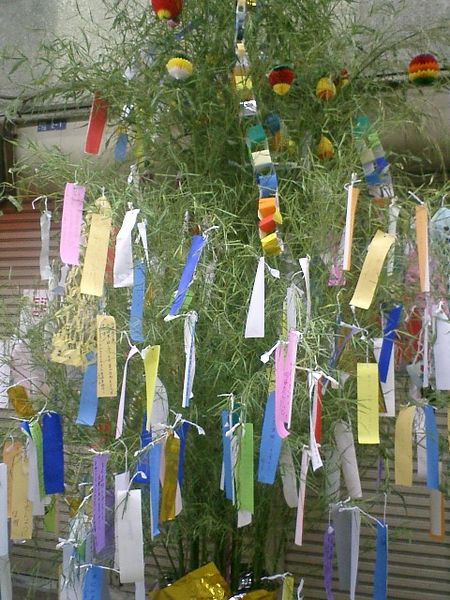
Apparently not enough of the kindergarteners wished for pleasant weather (which is, ahem, the traditional wish, OK?), because it rained like a mother here yesterday. Which, appropriately enough, drenched all of their paper wishes that we tied to bamboo shoots. It's OK, half of them were wishes to become goseija (Power Rangers) or Pretty Fresh Cure anyway. Also, in the picture cards we used to tell the students an English version of the Tanabata story, one of the pages said nothing but "Hikobuta was a Japanese cowboy." Man, why don't we have any American holidays that involve cowboys?

Jolly Star Festival, everyone!